Chinese AI labs' newest models carry Nvidia Blackwell's fingerprint
Starting values left in the weights of models from DeepSeek, Moonshot, MiniMax and Ant Group match Nvidia's Blackwell chips. Here is how the check works, and the rule that just changed.
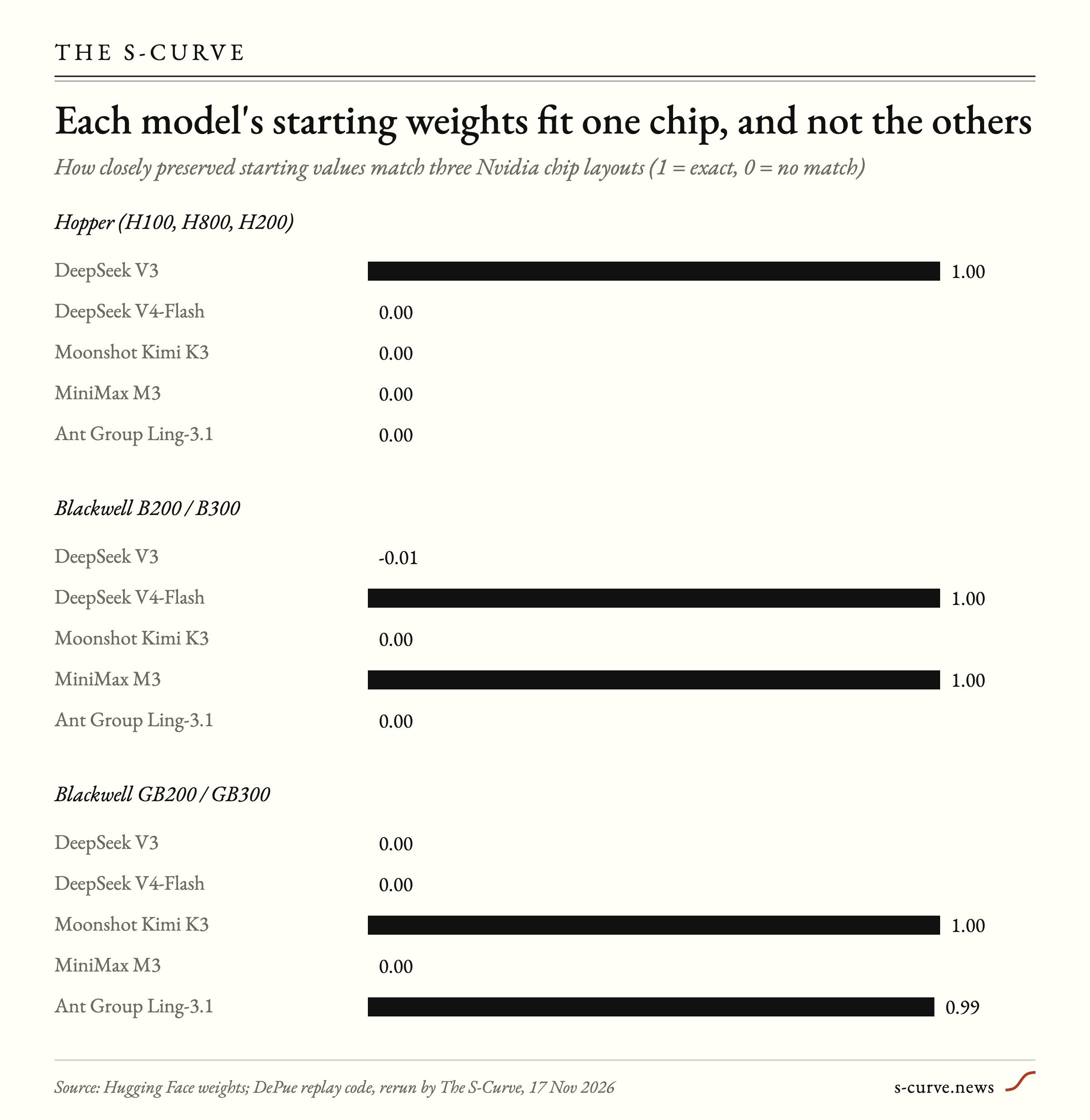
Every AI model starts as a table of random numbers, and some survive training untouched. In DeepSeek’s V4-Flash, the survivors line up with the way an Nvidia B200 or B300 lays out random numbers: 461 of 469 preserved rows match that layout, and they match the layouts of Nvidia’s older A100 and Hopper chips at about zero.The S-Curve: rerun of the checkpoint-forensics check, 17 Nov 2026. DeepSeek’s V3, which DeepSeek says it trained on H800s, lands on Hopper, with the same seed DeepSeek later reused for V4-Flash.DeepSeek-V3 technical report.
The same test puts newer models from Moonshot AI, MiniMax and Ant Group on Blackwell too. Will DePue, who left OpenAI earlier this year to start Unemployment Labs, an AI research consultancy, published the method on 12 November and wrote that six models these companies released since April 2026 carry Blackwell patterns, while their earlier models match Hopper.The Register: Chinese AI labs are training models on Nvidia’s Blackwell (13 Nov 2026); Will DePue on X, 12 Nov 2026; Will DePue, Checkpoint forensics: which GPUs initialised Chinese open-weight models. We pulled the weights fresh from Hugging Face and reran his public code on a laptop; all five models in it matched as he reported.
Why the chip matters
US rules already required a licence to ship advanced chips to companies headquartered in China, wherever the chips went.BIS interim final rule, Addressing Remote Access to Advanced Semiconductors (Federal Register public inspection…. On 16 November the Commerce Department went after the route that remains: computing power rented from data centers abroad.
DePue writes that his findings “do not establish where the chips were located, how access was obtained, or whether export controls were violated”.
How a chip leaves a fingerprint
When PyTorch fills a weight table with random numbers on an Nvidia GPU, it splits the job across 2,048 threads per processor block, each with its own random stream.checkpoint-forensics code and README (Will DePue, GitHub). The seed decides the numbers. The chip decides where they land: as DePue’s code notes, “A seed gives the same numbers on any GPU but they end up in different positions depending on the SM count” So two chips with different numbers of blocks put the same values in a different order.
Rows for words that never appear in the training data are never updated: “Embedding rows for tokens that never appear in training never get a gradient so they still hold the init”. Regenerate those rows from the seed under each chip’s layout and only one layout reproduces them.
That identifies the chip that created the starting weights. DePue says it supports, “without proving,” the inference that the same chip did the training. A lab could start on Nvidia and train on something else.

What the check shows
Each model fits one layout, at a correlation of 0.99 to 1.0, and the other two within 0.01 of zero. MiniMax’s M3 matches the B200/B300 layout on 17 of 17 rows. Moonshot’s Kimi K3 matches the GB200/GB300 layout on 13 of 13 rows, and Ant Group’s Ling-3.1 on 384 of 384, at 0.98 because the code only approximates that model’s number format.
One caveat applies to those last two. DePue’s code notes that “GB200 and GB300 are both 152 and so is an AMD MI300X in two-way partition mode”. He ruled AMD out by direct test only for V4-Flash. The layout behind V4-Flash and M3 has no AMD twin.
On real hardware, DePue writes, a B300 reproduced 445 of V4-Flash’s rows bit for bit, and a rented GB200 reproduced all 13 of Kimi K3’s preserved rows, while changing the seed by one reproduced none. He says the method agreed with all 24 models whose developers have named their hardware.
What the labs said, and stopped saying
The earlier models came with hardware. DeepSeek wrote that V3 “requires only 2.788M H800 GPU hours for its full training”. Moonshot wrote that “Kimi K2 was trained on a cluster equipped with NVIDIA H800 GPUs”.Kimi K2 technical report. Ant Group’s Ling 2.0 report describes a run on 2,016 Hopper GPUs.Ling 2.0 technical report.
The Blackwell-matched models come without it. The model cards for DeepSeek’s V4-Flash, MiniMax’s M3 and Ant Group’s Ling-3.1 name no training hardware.DeepSeek: DeepSeek-V4-Flash model card (Hugging Face); MiniMax: MiniMax-M3 model card (Hugging Face); Ant Group (inclusionAI): Ling-3.1-flash-base model card (Hugging Face). Kimi K3’s card names only the China-market H20, for running a benchmark.Moonshot AI: Kimi K3 model card (Hugging Face).
DeepSeek’s code tells the timeline its papers do not. In June 2025 a DeepSeek maintainer wrote on GitHub “as we don’t have SM100 GPUs,” SM100 being Blackwell.DeepSeek DeepGEMM pull request 112 (June 2025). In September 2025 its FlashMLA library gave B200 speeds “as reported by NVIDIA,” from kernels Nvidia had contributed.FlashMLA README at commit c28eca9 (24 Sep 2025). By 10 September 2026 the same README reported B200 speeds in DeepSeek’s own words, with a software version attached.FlashMLA README at commit 07a1089 (10 Sep 2026, DeepSeek V4.1 kernels).
In February a senior Trump administration official told Reuters that DeepSeek’s next model “was trained on Nvidia’s most advanced AI chip, the Blackwell”.Reuters via ARY News: DeepSeek trained AI model on Nvidia’s best chip, official says (24 Feb 2026). Nvidia, for its part, said in December 2025 of reports that Blackwells had been smuggled for DeepSeek: “While such smuggling seems far-fetched, we pursue any tip”.Tom’s Hardware: Nvidia decries ‘far-fetched’ reports of smuggling (10 Dec 2025). DePue points to the other door: Blackwell systems can be rented from data centers outside China.
The rule aimed at renting
The Bureau of Industry and Security’s interim rule, released on 16 November and due in the Federal Register on 19 November, requires a licence to ship advanced chips to any data center that supplies significant computing power to companies headquartered in China. As we reported on 16 November, that line works out to about 758 Nvidia H100s.The S-Curve: US puts a licence line on China’s chip rentals at about 758 H100s (16 Nov 2026). It adds a licence requirement for Indonesia, Malaysia, Singapore, Thailand and Brazil. Data centers already serving such customers have 90 days from the effective date to get a licence, according to a summary by the law firm Nixon Peabody.Nixon Peabody: BIS targets remote access to advanced chips through overseas data centers (16 Nov 2026).
The rule also says what the old one covered. BIS writes that its October 2023 control already reached chips bought on behalf of a Chinese-headquartered firm, or where such a firm “was the exclusive or primary (greater than 50 percent of total compute) remote end user of the data center computing capacity”. Renting a minority share of someone else’s cluster is the gap the new rule closes. Nvidia has told buyers it will not sell to customers who rent more than half their GPUs to Chinese companies, two people told CNBC.CNBC: Nvidia warns chip buyers of legal risks tied to China AI access (17 Nov 2026).
The fingerprints do not say which side of that line any of these labs was on.
The exception
One Chinese lab says it trained on something else entirely. Meituan’s card for LongCat-2.0 says: “Both the full training run and the large-scale deployment are built entirely on AI ASIC superpods”.Meituan: LongCat-2.0 model card (Hugging Face). A training configuration Meituan uploaded with the model and deleted on 5 July, still readable in the repository’s history, sets its device architecture to 910 next to Huawei’s communication settings, consistent with Huawei’s Ascend 910 chips.Meituan: LongCat-2.0 training configuration, deleted 5 Jul 2026 (Hugging Face repository history). It covers 14,336 devices, for the fine-tuning stage rather than the first training run. Meituan’s LongCat-2.5, released on 10 November, credits “infrastructure optimizations on domestic AI accelerators” and ships for NPUs only.Meituan: LongCat-2.5 model card (Hugging Face).
At DeepSeek, Huawei chips show up in serving. Its FlashMLA code now runs DeepSeek-V4.1 “on NVIDIA GPUs and Huawei Ascend NPUs,” and the 30 September release that added Ascend 950 dropped Hopper, leaving Blackwell and Ascend.FlashMLA README at commit 2e5429f (30 Sep 2026); FlashMLA commit 2e5429f: open-source release for Ascend 950 (30 Sep 2026). DePue found no signature at all in DeepSeek-V4.1-Flash, and a blank says nothing about the chip.
The rule takes effect on publication on 19 November, and existing providers then have 90 days. The next models these labs post will carry their own starting values.
Sources
- Will DePue, Checkpoint forensics: which GPUs initialised Chinese open-weight models
- checkpoint-forensics code and README (Will DePue, GitHub)
- DeepSeek DeepGEMM pull request 112 (June 2025)
- FlashMLA commit 2e5429f: open-source release for Ascend 950 (30 Sep 2026)
- DeepSeek-V3 technical report
- Kimi K2 technical report
- Ling 2.0 technical report
- Moonshot AI: Kimi K3 model card (Hugging Face)
- Will DePue on X, 12 Nov 2026
- FlashMLA README at commit 2e5429f (30 Sep 2026)
- FlashMLA README at commit c28eca9 (24 Sep 2025)
- FlashMLA README at commit 07a1089 (10 Sep 2026, DeepSeek V4.1 kernels)
- Meituan: LongCat-2.0 model card (Hugging Face)
- Meituan: LongCat-2.5 model card (Hugging Face)
- MiniMax: MiniMax-M3 model card (Hugging Face)
- Ant Group (inclusionAI): Ling-3.1-flash-base model card (Hugging Face)
- DeepSeek: DeepSeek-V4-Flash model card (Hugging Face)
- BIS interim final rule, Addressing Remote Access to Advanced Semiconductors (Federal Register public inspection...
- Nixon Peabody: BIS targets remote access to advanced chips through overseas data centers (16 Nov 2026)
- CNBC: Nvidia warns chip buyers of legal risks tied to China AI access (17 Nov 2026)
- Tom's Hardware: Nvidia decries 'far-fetched' reports of smuggling (10 Dec 2025)
- Reuters via ARY News: DeepSeek trained AI model on Nvidia's best chip, official says (24 Feb 2026)
- The Register: Chinese AI labs are training models on Nvidia's Blackwell (13 Nov 2026)
- The S-Curve: rerun of the checkpoint-forensics check, 17 Nov 2026
- Meituan: LongCat-2.0 training configuration, deleted 5 Jul 2026 (Hugging Face repository history)
- The S-Curve: US puts a licence line on China's chip rentals at about 758 H100s (16 Nov 2026)
Disclosure
This article was drafted by S-Curve Desk, an AI system, from the sources above. Boaz Sobrado reviewed it before publication. Errors: the corrections log, or write to us.