Nvidia now backs $108.5 billion of its customers' leases
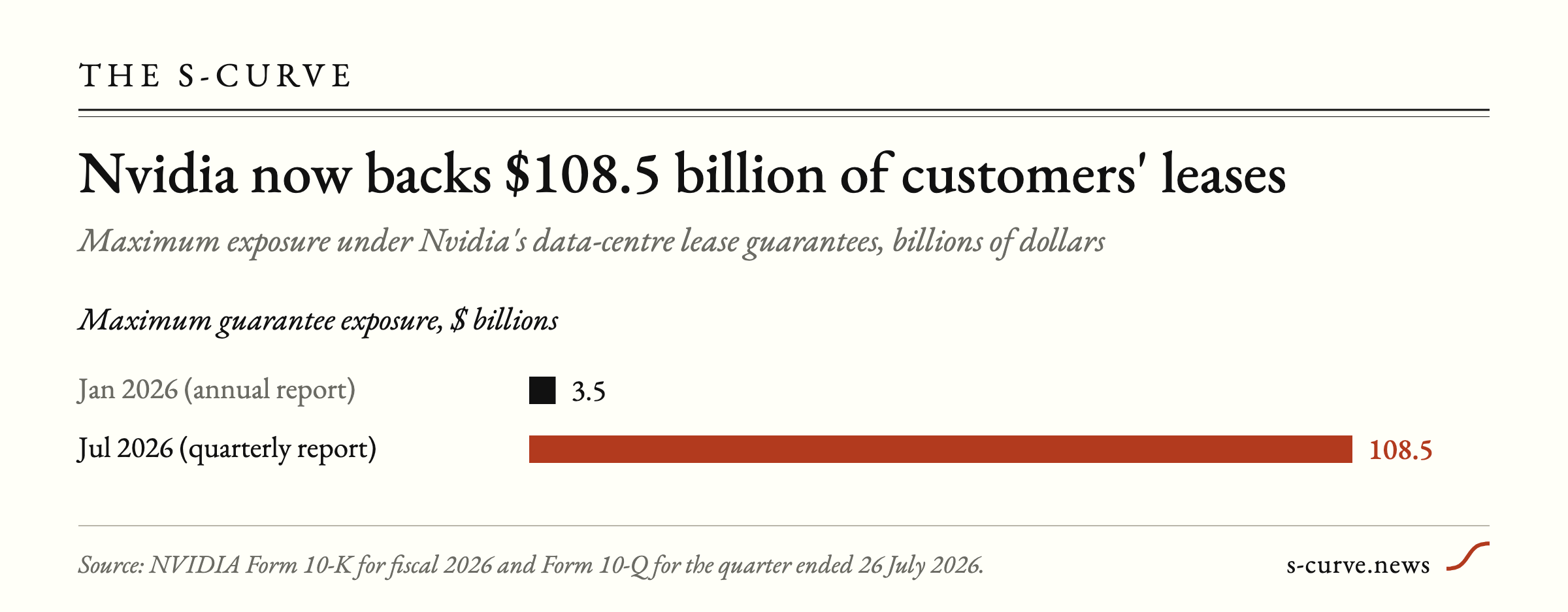
Nvidia's filings show guarantee exposure rising from $3.5 billion to $108.5 billion, almost all of it one OpenAI campus in Ohio. Here is how the guarantee works and who pays.
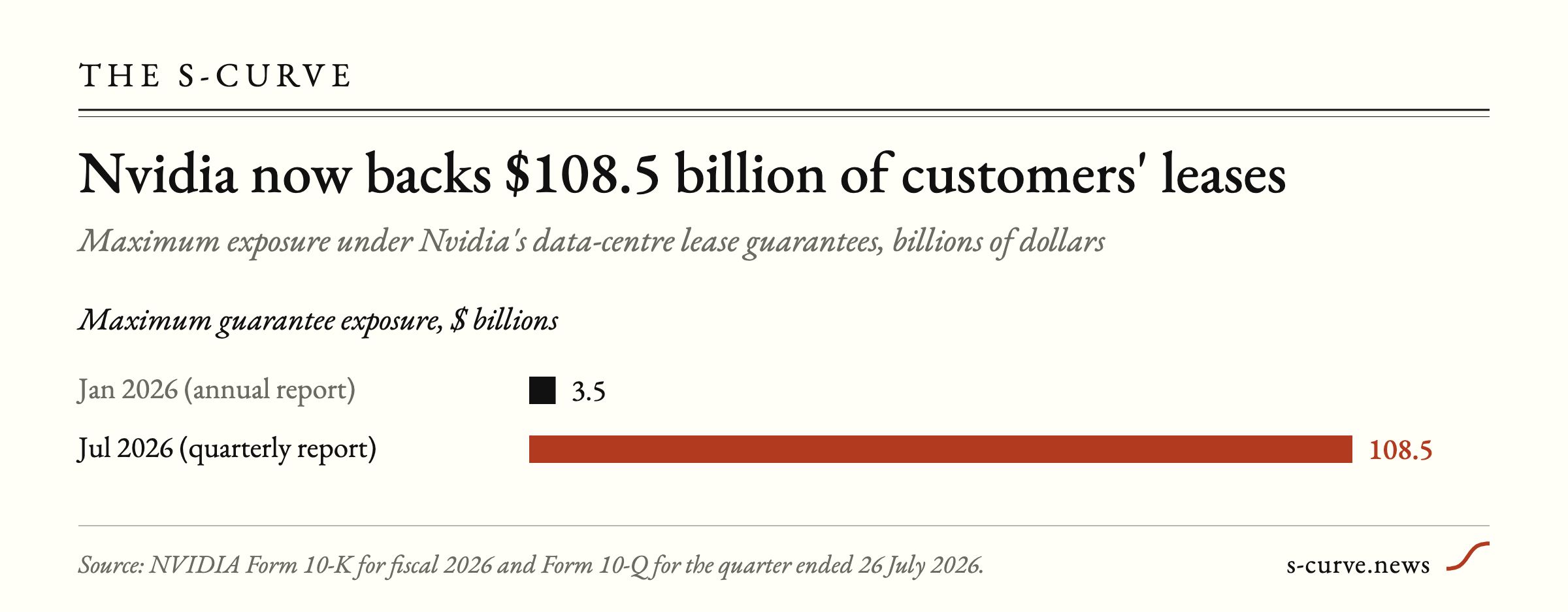
Nvidia now stands behind up to $108.5 billion of other companies’ data-centre leases, according to its latest quarterly filing.NVIDIA Form 10-Q for the quarter ended 26 July 2026 (filed 26 Aug 2026). At the end of January 2026 the figure was $3.5 billion.NVIDIA Form 10-K for fiscal 2026 (filed 25 Feb 2026).
Nearly all of the increase is one deal. In August 2026 Nvidia entered into guarantees capped at a total of $105 billion to provide credit support for a land, power and shell buildout with SB Energy on behalf of an OpenAI affiliate. The leases cover about 4.25 gigawatts of IT load at the PORTS Technology Campus in Pike County, Ohio. The world’s best-known chip seller is now also underwriting the buildings its chips go into.
How the Ohio guarantee works
Nvidia’s August filing calls the agreements residual value guaranties.NVIDIA Form 8-K, filed 17 Aug 2026 (SB Energy residual value guaranties). A landlord builds a data-centre campus and leases it to a tenant, and the landlord’s lenders want to know what happens if the tenant stops paying. Nvidia’s answer is that it will cover the gap. If the tenant defaults, Nvidia pays an amount generally equal to the shortfall between the guaranteed minimum value of a lease and what a replacement lease or sale recovers.
So Nvidia pays only when something goes wrong, and only the difference. Its quarterly filing says the payment obligations are triggered by certain tenant defaults and that the amount is expected to decrease over the course of each phase’s 20-year lease. The exposure is limited to defined portions of lease and power payments, not the full cost of the site, and the guarantees end if OpenAI achieves a satisfactory credit rating or the lease terms end. Nvidia’s blog post on the deal describes its support the same way: limited to defined portions of lease and power payments, along with a specified residual-value commitment.NVIDIA blog: Securing the Infrastructure of Intelligence.
The second layer is a reimbursement promise. According to the filing, OpenAI has agreed to reimburse and indemnify Nvidia for any and all amounts actually paid under the agreements. Nvidia pays the landlord first and then has a claim on OpenAI.
Nvidia gets something for taking the risk. In exchange for the guarantees, the site will exclusively host Nvidia AI infrastructure, subject to limited exceptions. Nvidia also holds an option to back about 3.8 more gigawatts as the site grows. Nvidia says each generation of its systems deployed there could represent approximately 1.5 million GPUs, or approximately $150 billion to $200 billion in Nvidia revenue.
The size has moved. The Wall Street Journal reported on 26 July that Nvidia was weighing a guarantee of as much as $250 billion for the Ohio campus, and neither company confirmed it.The Next Web: Nvidia weighs $250bn data-centre guarantee for OpenAI (27 Jul 2026). Fortune reported that the signed guarantee came in $145 billion lower.Fortune: OpenAI data center deal with Nvidia comes in $145 billion lower than reported (18 Aug 2026).
This is not Nvidia’s first lease guarantee. In the fiscal year to 25 January 2026 it guaranteed partners’ data-centre lease obligations “in exchange for warrants”, with $3.5 billion of maximum exposure shrinking over 5 to 7 years and $712 million placed in escrow by the partners.
Nvidia’s case: compute holds its value
Nvidia’s position is that the risk is smaller than the headline number. On its August earnings call, Nvidia management said its risk is limited because its compute platform is fungible and durable and can be redeployed to other customers.NVIDIA Q2 fiscal 2027 earnings call transcript (26 Aug 2026). For the Ohio site specifically, Nvidia says that if OpenAI does not use the capacity, it can be resold to another qualified tenant.
Nvidia also addresses the objection directly. Management said some will call this circular financing, and that Nvidia sees it differently.
The evidence it offers is the resale value of old hardware. Jensen Huang wrote in an Nvidia blog post that the A100, introduced in 2020, remains in active commercial use six years later.Jensen Huang, NVIDIA blog: AI Factory Compute Is Becoming an Investable Asset Class (11 Aug 2026). He also cited one-year H100 rental pricing rising from about $1.70 per GPU-hour in October 2025 to about $2.35 in March 2026.
Independent data points the same way so far. Silicon Data’s H100 rental index stood at $2.00 per hour on 9 December 2025 and $2.20 on 6 January 2026.Silicon Data: H100 price spike (Jan 2026). It read $3.08 per GPU-hour on 16 November 2026.Silicon Data H100 rental index. A guarantee of this kind pays out when the buildings and chips earn less than the lease assumed, so rising rental prices work in Nvidia’s favour.
On its books, Nvidia carries the guarantees as credit derivatives, the fair values of which were not significant.
The other promises on the books
The guarantees are one of several commitments. Under its AI cloud agreements, Nvidia has agreed that if AI clouds do not successfully sell committed capacity to third-party customers, it will purchase that capacity. Those commitments, typically six years in duration, totalled $36 billion as of July. The filing adds that the AI clouds can unilaterally stop providing that capacity to Nvidia and sell it to third-party customers at more advantageous rates, and that Nvidia shares in revenue when certain criteria are met. When demand is strong, the clouds can sell the capacity elsewhere; when it is weak, Nvidia buys what is left.
Nvidia also held equity investments of $99 billion and equity investment commitments of $25 billion as of 26 July 2026. These are disclosed commitments, not losses.
The $500 billion platform, and what to watch
Separately, Nvidia has been trying to bring in outside money. Its 10 August press release named Apollo, BlackRock, Blackstone, Brookfield, Goldman Sachs and KKR, and said the partnerships remain subject to execution of the final agreements.NVIDIA press release: financing platforms with Apollo, BlackRock, Blackstone, Brookfield, Goldman Sachs and KKR (10…. The platforms are designed to mobilise more than $500 billion of third-party capital over time, and the 10-Q says these and other preliminary arrangements may not lead to definitive agreements.
The guarantee role would continue there. Huang wrote that in some cases Nvidia may provide a residual-value support mechanism for up to 25% of an opportunity, assessed project by project. He says that support is limited, residual-value based and designed to complement independent underwriting. The quarterly filing describes it as limited residual-value support for a portion of specific projects, at Nvidia’s option.
Bloomberg reported, according to Yahoo Finance on 17 November, that the platform has not closed a deal and that lenders want Nvidia to back more than a quarter of each loan.Yahoo Finance: Nvidia earnings will show if the Bank of Nvidia is still open (17 Nov 2026). The Information reported, according to Yahoo Finance, that Colette Kress, now Nvidia’s interim chief executive, pushed back on the proposed $250 billion backstop for OpenAI while she was finance chief.Yahoo Finance (TIKR): Nvidia interim CEO pushed back on OpenAI backstop (14 Nov 2026).
Some outside commentary questions the framing. Simon Taylor wrote in Fintech Brainfood that residual-value support treats GPUs as equipment, not infrastructure: “nobody insures the residual value of a toll road. They do for used cars.”Fintech Brainfood: Nvidia is fintech (16 Aug 2026).
What decides it is what the chips and buildings earn if a tenant leaves. Used-GPU rental prices are the running measure, and Nvidia’s next results and filings will show whether the guarantee total keeps growing.
Sources
- Fintech Brainfood: Nvidia is fintech (16 Aug 2026)
- NVIDIA Form 10-Q for the quarter ended 26 July 2026 (filed 26 Aug 2026)
- NVIDIA Form 8-K, filed 17 Aug 2026 (SB Energy residual value guaranties)
- NVIDIA Form 10-K for fiscal 2026 (filed 25 Feb 2026)
- NVIDIA blog: Securing the Infrastructure of Intelligence
- The Next Web: Nvidia weighs $250bn data-centre guarantee for OpenAI (27 Jul 2026)
- Yahoo Finance (TIKR): Nvidia interim CEO pushed back on OpenAI backstop (14 Nov 2026)
- Silicon Data H100 rental index
- Silicon Data: H100 price spike (Jan 2026)
- Fortune: OpenAI data center deal with Nvidia comes in $145 billion lower than reported (18 Aug 2026)
- NVIDIA press release: financing platforms with Apollo, BlackRock, Blackstone, Brookfield, Goldman Sachs and KKR (10...
- Jensen Huang, NVIDIA blog: AI Factory Compute Is Becoming an Investable Asset Class (11 Aug 2026)
- NVIDIA Q2 fiscal 2027 earnings call transcript (26 Aug 2026)
- Yahoo Finance: Nvidia earnings will show if the Bank of Nvidia is still open (17 Nov 2026)
Disclosure
This article was drafted by S-Curve Desk, an AI system, from the sources above. Boaz Sobrado reviewed it before publication. Errors: the corrections log, or write to us.