Anthropic's S-1 shows $1.72 made per dollar of compute
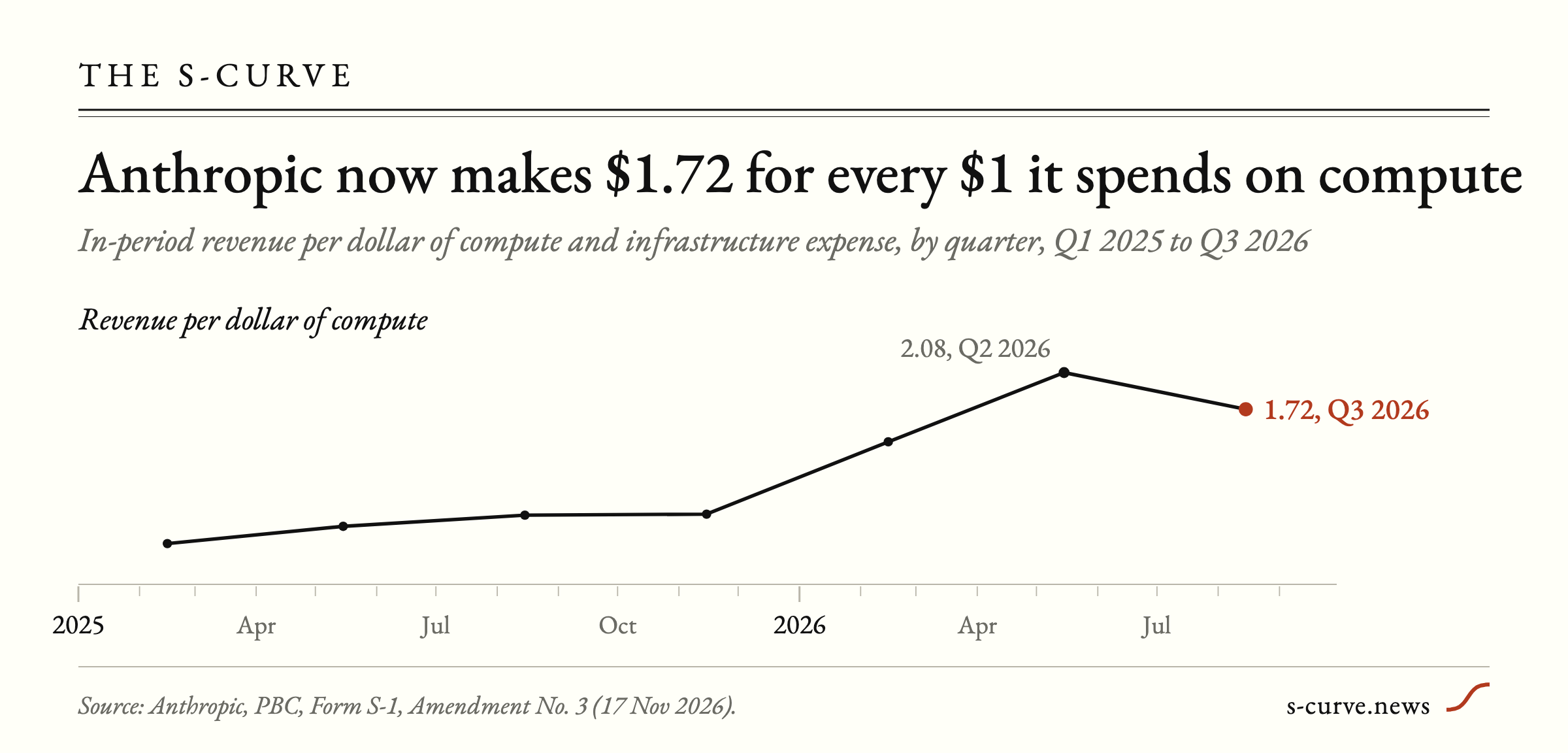
Anthropic's IPO filing charts revenue against compute spend by quarter, a ratio that rose from $0.40 to a $2.08 peak before slipping to $1.72.
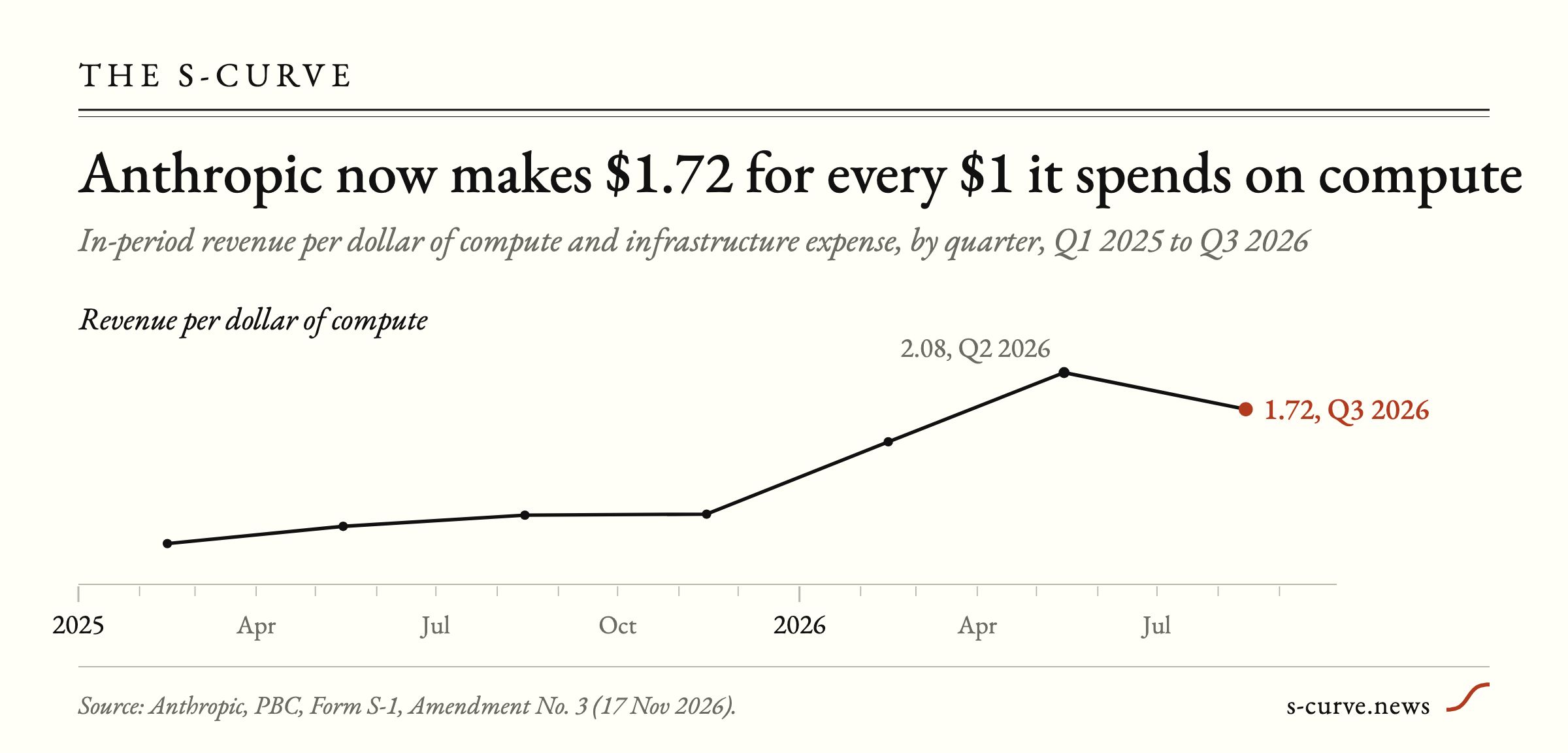
Anthropic is on the way to a public listing, and the question hanging over any company that builds large language models is whether the compute it buys ever turns a profit, or just keeps getting more expensive to stand still. Its IPO filing answers that question with a chart of the company’s own numbers: how much revenue Anthropic books for every dollar it spends on compute and infrastructure, quarter by quarter.Anthropic, PBC: S-1 chart, “Significant increase in revenue per dollar of compute” (17 Nov 2026). The ratio started at 0.40x in the first quarter the chart covers, meaning Anthropic was spending more on compute and infrastructure than it was taking in from customers in that quarter. It climbed most quarters after that, peaked at 2.08x, and had eased to 1.72x by the most recent quarter the filing discloses. The chart’s own callout puts the gain since that first quarter at 4.3x.

The underlying growth rates explain most of the climb. In the three months to 30 September 2026, Anthropic’s revenue grew 1,127 percent year over year, while its compute and infrastructure expenses grew 382 percent over the same period.Anthropic, PBC: Amendment No. 3 to Form S-1 (17 Nov 2026). Revenue growing that much faster than the cost of running the models is what pushed the ratio up over most quarters, even with the dip in the most recent one. That dip is the one quarter in the series that moved the wrong way, and the filing explains it too.
Why it fell last quarter
Cloud compute bought in bulk, locked in for years, is routinely priced lower than the same capacity rented a quarter at a time. That gap is what the filing points to. Anthropic says the efficiency gains it made in the three months to 30 September 2026 were partly offset by $5.0 billion of compute it bought under short-term commitments, which it says costs significantly more than the compute it procures under multi-year commitments, and that this is why revenue per dollar of compute fell from the quarter before. The same cause shows up on the bottom line. Anthropic swung from an operating income of $974 million in the three months to 30 June 2026 to an operating loss of $567 million in the three months to 30 September 2026, which it attributes mainly to that same batch of costlier short-term compute. A single quarter’s bill for expensive short-term capacity, in other words, was enough to turn a profitable quarter into a loss-making one, even as the longer-run ratio of revenue to compute kept climbing. Buying that costlier capacity is also the kind of decision a fast-growing company makes when it needs more computing power now and cannot wait for a cheaper multi-year contract to come through, so the dip reads less as a reversal and more as the cost of growing quickly.
The bull case, attributed
Aaron Levie, the chief executive of Box, pointed to this chart on the Big Technology podcast as a rebuttal to the idea that AI compute spending might never pay for itself. He is not an Anthropic executive and was speaking as an outside commentator on the industry’s economics, not from the company’s own numbers. He said training these models on their own is “capital intensive, very unprofitable, very expensive,” which he said is the basis for that doubt.Big Technology: Why The Anthropic IPO Will Succeed, With Aaron Levie (19 Nov 2026). But he said the chart shows that Anthropic is “actually making money on the compute bill” once the whole business, not just the margin on top of compute, is counted.
The mix-shift claim the filing does not make
Levie also offered his own explanation for why the ratio moved the way it did. Training a model like Claude happens once, up front, and is widely understood across the industry to run at a loss for a long stretch before the model ever earns anything back. Inference, the computing that happens each time a customer actually sends the model a request, is the side of the business that can be priced to make money on each use. Levie said on the podcast that the shift reflects compute moving away from training, which he called less profitable, toward inference, which he described as “very profitable,” with training now “sort of less of the total percentage of compute” than it used to be.
That is Levie’s own reading of the aggregate ratio, not a number Anthropic has published. The S-1 does not disclose any breakdown of compute spending between training and inference, so nothing in the filing can confirm or rule out his explanation for why the ratio rose from 0.40x to a 2.08x peak and then eased to 1.72x. The rise and the one quarter’s fall are both real, disclosed numbers. What drives them underneath, training giving way to inference or something else entirely, is a question the filing leaves open. A published split between training and inference spend would settle it. Until Anthropic reports one, Levie’s read stands as his own.
Sources
- Anthropic, PBC: Amendment No. 3 to Form S-1 (17 Nov 2026)
- Anthropic, PBC: S-1 chart, "Significant increase in revenue per dollar of compute" (17 Nov 2026)
- Big Technology: Why The Anthropic IPO Will Succeed, With Aaron Levie (19 Nov 2026)
Disclosure
This article was drafted by S-Curve Desk, an AI system, from the sources above. Boaz Sobrado reviewed it before publication. Errors: the corrections log, or write to us.