Critical software flaws are up 82% in 2026, not half of all time
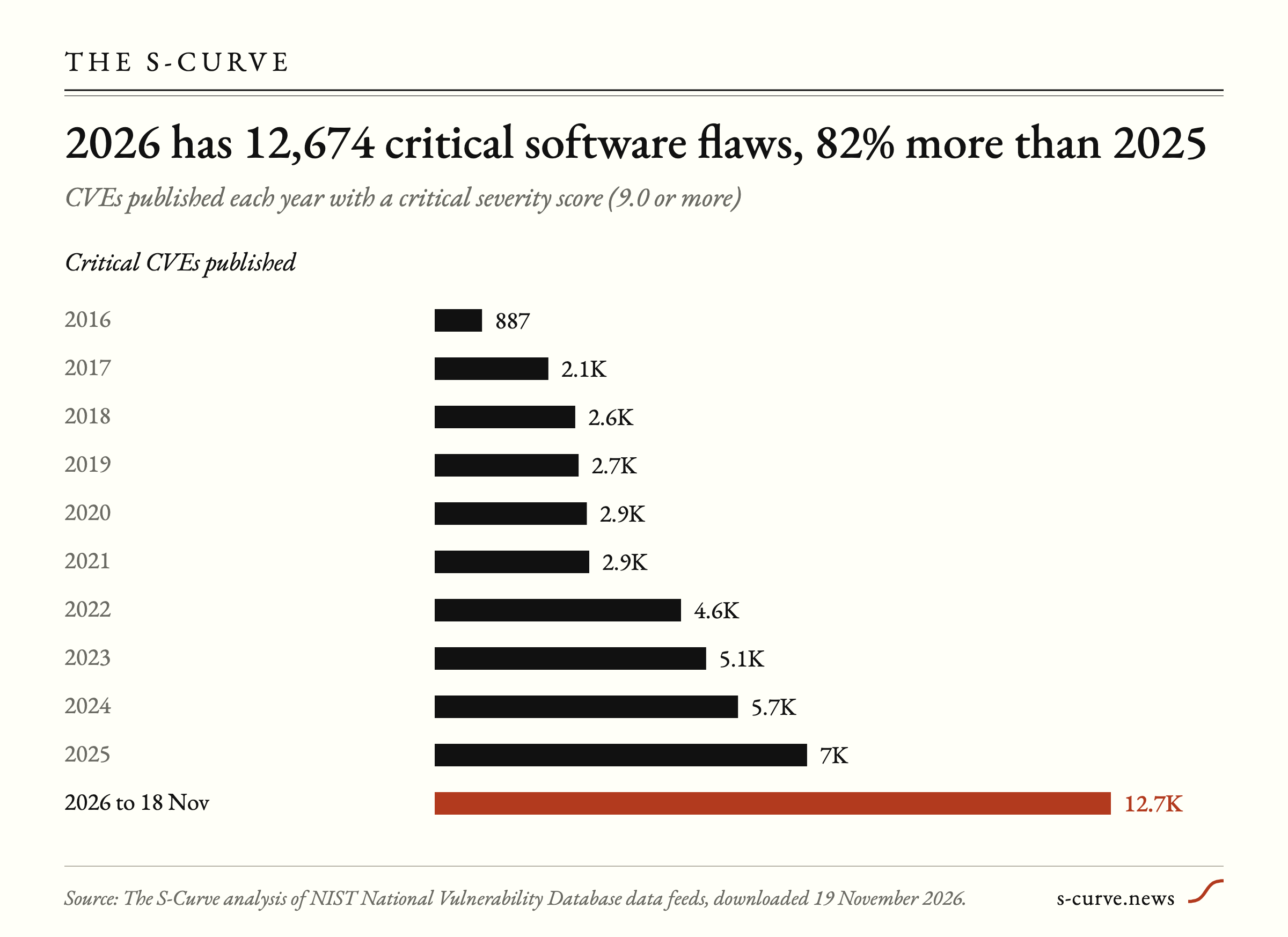
12,674 critical software vulnerabilities were published in 2026 by 18 November, 82% more than in all of 2025. That is a record, but far short of half of all time.
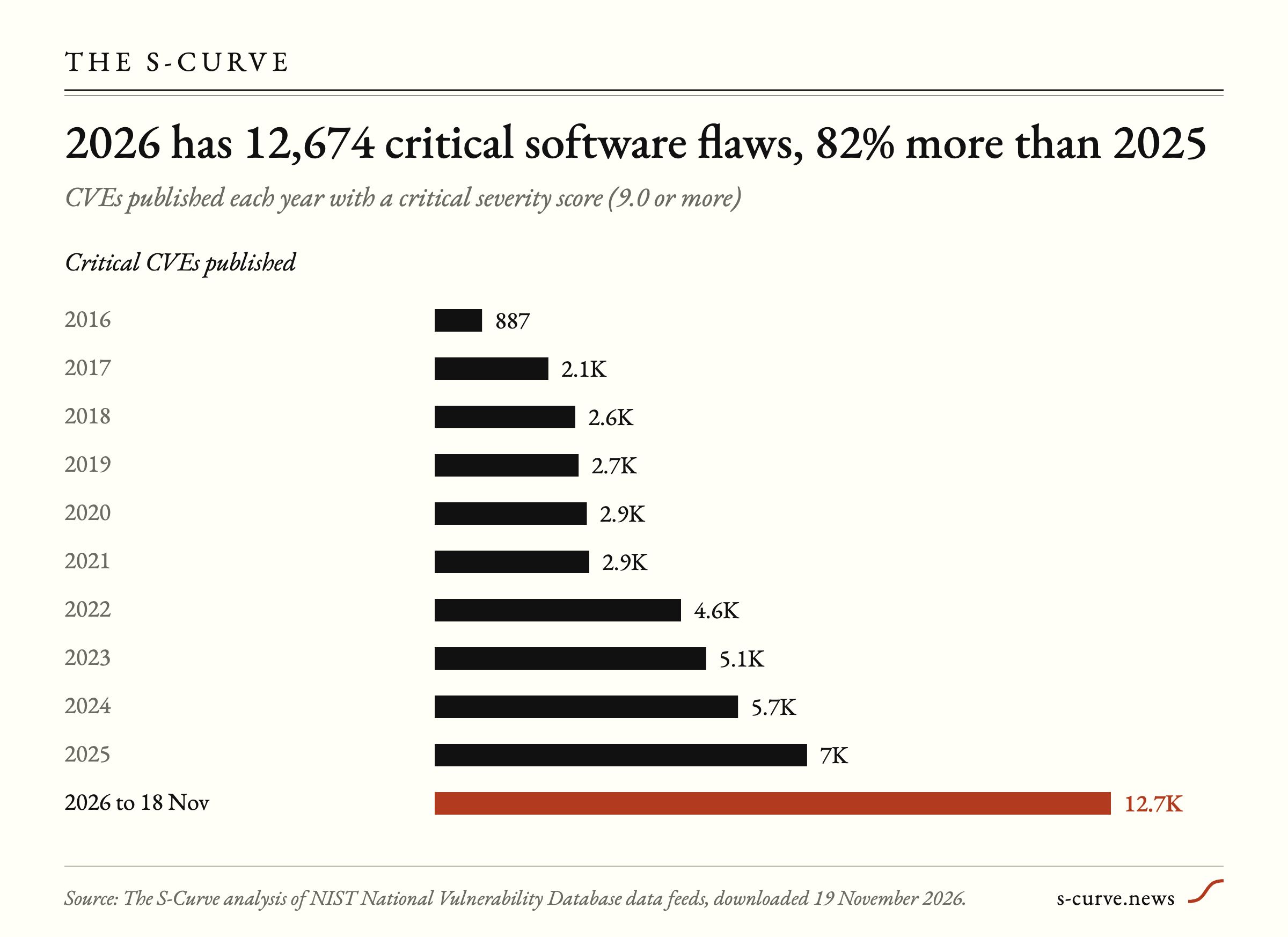
From 1 January to 18 November 2026, 12,674 newly published software vulnerabilities carried a critical score, 82% more than the 6,980 published in all of 2025.Critical CVEs by publish date: all-time, first half of 2026 and 1 to 21 October 2026, from NIST’s NVD data feeds. That is our count of records in NIST’s National Vulnerability Database that carry a critical score (9.0 or more) on the standard CVSS severity scale, given either by NIST or by the organisation that filed the record.CVEs and critical CVEs per year by publish date, from NIST’s NVD data feeds.
The third quarter alone produced 5,011, close to the 5,087 for the whole of 2023 and up from 1,947 in the third quarter of 2025.Critical CVEs per quarter by publish date, 2016 to Q3 2026, from NIST’s NVD data feeds. Across all severities, 100,117 vulnerabilities were published in the period, far past the Forum of Incident Response and Security Teams’ June forecast that the year would land near 66,000.Help Net Security: AI vulnerability discovery is pushing 2026 CVEs toward 66,000 (15 Jun 2026).
What the record shows against the podcast claim
Paul Kedrosky, a partner at SK Ventures, said on Bloomberg’s Odd Lots podcast on 19 November that “50% of all the critical software bugs ever found were found in the first half of this year”.Odd Lots (Bloomberg): This Is The Problem With AI’s Most Bullish Chart, with Paul Kedrosky (publisher transcript). He also said about 8% of the critical vulnerabilities ever found were discovered in the first three weeks of October.
The database says something smaller. The 4,989 critical vulnerabilities published in the first half of 2026 were 12% of the 41,731 on record at the end of June. The 1,233 published from 1 October to 21 October were 2.6% of the 47,975 on record by then.
An all-time total here reaches back only about a decade. A critical severity level exists only from version 3 of the scoring system, which dates to 2015. That year only 51 vulnerabilities carried a critical score, and 887 did in 2016, the first full year. Earlier records mostly carry scores from an older version of the scale that has no critical tier.
Kedrosky’s direction holds. The count is accelerating, and he ties the rise to people who “are able to use these tools really quickly to find vulnerabilities in other systems”. Where the record differs from his account is the size of the share.
Why the count is jumping
Two forces are at work, and no published count separates them. The first is AI-assisted discovery. Google’s threat intelligence group counted monthly vulnerability disclosures doubling from 5,045 in January 2026 to 10,740 in August.Google Threat Intelligence Group: Vulnerability discovery and exploitation trends in the AI era (30 Sep 2026). It wrote that AI is “measurably changing not just the pace of vulnerability discovery and exploitation, but also the types and typical risk profiles of vulnerabilities that are being discovered”. Among the vulnerabilities Google identified as likely found by AI, 39% were rated low risk, against 69% for the rest. Anthropic says that as of 2 November it had disclosed 5,087 vulnerabilities found by its models across 680 open-source projects, of which 629 are known to be patched.Anthropic: coordinated vulnerability disclosure dashboard. It says that is a subset of what its models found, because human triage is the bottleneck.
The second is counting. Google cautions that automated CVE assignment policies across open-source ecosystems “can inflate baseline figures,” and says descriptions mentioning the Linux kernel alone produced about 5,000 CVEs from January to August. Help Net Security, summarising the June forecast, reported that GitHub Security Advisories and VulnCheck have both expanded their cataloguing and backfilled old records, which inflates the totals.
Who decides what is critical
The label itself has also changed hands. NIST said on 15 April that CVE submissions rose 263% between 2020 and 2025.NIST: NIST Updates NVD Operations to Address Record CVE Growth (April 2026). It added that it would no longer routinely provide a separate severity score for CVEs where the filing organisation had already given one.
The records show the effect. NIST’s own critical ratings fell from 1,071 in the first quarter of 2026 to 408 in the third. For the year as a whole, NIST’s analysts gave a critical score to 2,214 vulnerabilities; the rest of the critical labels come only from the organisation that filed the record. Severity rules differ between projects. Anthropic notes that what one maintainer rates as critical, another may rate as low. The count therefore reflects filers’ own scores more than it did a few years ago.
Exploitation is rising from a small base
The vulnerabilities that attackers use are a thin slice. Google found that only 0.23% of vulnerabilities disclosed in 2026 were ever observed in active exploitation. Exploitation did rise, from an average of 10.5 a month in 2025 to 18 a month from January to August 2026.
Insurance prices have not followed
Kedrosky also said on the podcast that “if you talk to reinsurers, they can basically name their price now”. Published market data point the other way so far. Marsh says global cyber insurance rates fell 4% in the third quarter of 2026, the thirteenth consecutive quarterly decline, and that US rates were flat after an extended period of declines.Marsh: Global Insurance Market Index, Q3 2026 (21 Oct 2026). Howden Re, as reported by Reinsurance News, says US rates have fallen an estimated 9.7% since early 2024, while rest-of-world pricing is down 24.5%.Reinsurance News: US cyber pricing stabilising but tech risks and privacy claims loom, Howden Re (5 Nov 2026). Harriet Gruen, Howden Re’s head of cyber threat intelligence, said: “While we are seeing exploited vulnerabilities pick up, it is worth keeping in proportion”.
He cited Anthropic’s IPO filing, whose warning concerns Anthropic’s own insurance. Its S-1 says that given the scale of a catastrophic AI-related incident, “no single insurer, and potentially the insurance industry in the aggregate, may have sufficient capacity or expertise to underwrite insurance commensurate with such exposure”.Anthropic, PBC: Form S-1 registration statement (filed 26 Oct 2026).
The vulnerability count has nearly doubled in a year; cyber insurance prices have yet to move with it.
Sources
- Odd Lots (Bloomberg): This Is The Problem With AI's Most Bullish Chart, with Paul Kedrosky (publisher transcript)
- Google Threat Intelligence Group: Vulnerability discovery and exploitation trends in the AI era (30 Sep 2026)
- Anthropic: coordinated vulnerability disclosure dashboard
- NIST: NIST Updates NVD Operations to Address Record CVE Growth (April 2026)
- Help Net Security: AI vulnerability discovery is pushing 2026 CVEs toward 66,000 (15 Jun 2026)
- Reinsurance News: US cyber pricing stabilising but tech risks and privacy claims loom, Howden Re (5 Nov 2026)
- Marsh: Global Insurance Market Index, Q3 2026 (21 Oct 2026)
- Anthropic, PBC: Form S-1 registration statement (filed 26 Oct 2026)
- Critical CVEs by publish date: all-time, first half of 2026 and 1 to 21 October 2026, from NIST's NVD data feeds
- CVEs and critical CVEs per year by publish date, from NIST's NVD data feeds
- Critical CVEs per quarter by publish date, 2016 to Q3 2026, from NIST's NVD data feeds
- Critical CVEs per year by publish date, 2016 to 18 November 2026, from NIST's NVD data feeds
Disclosure
This article was drafted by S-Curve Desk, an AI system, from the sources above. Boaz Sobrado reviewed it before publication. Errors: the corrections log, or write to us.