ECB counts over $4 trillion of AI promises off big tech's books
Two central banks counted the leases, contracts and guarantees big tech discloses in footnotes but does not carry as debt. How they work, and what worries regulators.
The European Central Bank estimates that big tech firms had off-balance-sheet commitments of more than $4 trillion as of the second quarter of 2026, well in excess of their outstanding on-balance-sheet liabilities.ECB FSR November 2026, Box 3: The debt financing of AI and its implications for financial stability. Its tally covers eight firms: Alphabet, Amazon, Meta, Microsoft, Nvidia, Oracle, Broadcom and Anthropic, the last from its IPO filing.
Protos, reading the ECB’s chart, put the total at $4.5 trillion, 287% above the 2025 figure;Protos: ECB finds $4.5 trillion in hidden AI debt (19 Nov 2026). the ECB’s text says “more than USD 4 trillion”. The ECB calls the commitments debt-like in economic terms, but says they do not appear as liabilities on hyperscalers’ balance sheets under US accounting standards.
A second central bank, a similar count
The Federal Reserve Board’s November report counts not-yet-commenced leases with undiscounted values above $1 trillion, and take-or-pay contracts and residual value guarantees above $2 trillion, at Amazon, Alphabet, Broadcom, Meta, Microsoft, Nvidia and Oracle.Federal Reserve Board: Financial Stability Report, November 2026. Fed Governor Michael Barr said on 16 November that the report puts the potential maximum nominal value of these obligations above $3 trillion.Michael S. Barr: Some Potential Financial Stability Implications of Artificial Intelligence (16 Nov 2026).
None of this is secret. ECB staff extracted the figures from the companies’ public SEC filings using an AI agent built in-house, then cross-checked them manually.
How a promise stays off the balance sheet
The mechanism is an accounting timing rule. Under US standard ASC 842, the ECB explains, a lease is not recognised on the balance sheet until the asset’s use begins, even if the agreement was signed earlier. Under ASC 440, future obligations and significant contractual commitments must be disclosed in the notes to the financial statements. So the numbers are public, in footnotes, and the question is where they sit in the accounts.
The ECB splits them in two. Fixed commitments are lease payments or contractual purchases. Contingent ones are backstops and purchase obligations that become payable only if pre-specified conditions apply.
Behind many of them is a simple structure. Hyperscalers sign contracts to use data centres and chips owned by others, and the owners can borrow from banks, bond investors or private credit funds against those promised payments. Nvidia’s guarantee exposure is one example: as we reported on 18 November, Nvidia’s filings show it rising from $3.5 billion to $108.5 billion.The S-Curve: 2026-11-17-nvidia-108bn-lease-guarantees. Anthropic is another: as we reported on 19 November, its IPO filing puts its compute commitments at $900.9 billion.The S-Curve: 2026-11-18-anthropic-900bn-compute-commitments.
Money that comes back as demand
Cloud providers and AI labs buy and lease chips, and the chipmakers often finance those purchases. The ECB says such mutual finance commitments inflate the expected revenues of both the chipmaker and the service provider, because an involved firm’s reported demand is partly driven by its own financing decisions.
Equity stakes add a second loop. The ECB writes that “other income” reported by Alphabet and Amazon comes from revaluations of private equity stakes in Anthropic, and that Nvidia has acquired equity stakes in CoreWeave, OpenAI and Anthropic. Barr put the hyperscalers’ and large GPU producers’ cumulative equity investments in AI labs and cloud start-ups at over $100 billion.
He also gave the balancing view. These investments are a relatively small share of the big firms’ balance sheets, he said, but they are critical for the smaller firms receiving them, which will eventually have to replace that funding from suppliers with revenue from paying customers.
The mismatch regulators worry about
The ECB cites forecasts of about $5.5 trillion in cumulative capital spending by US big tech by 2030, though it says estimates vary widely. Free cash flows turned negative for most US hyperscalers in 2026, as spending on AI infrastructure exceeded operating cash flows. Hyperscalers have issued over $200 billion of US dollar investment-grade bonds this year.ECB FSR November 2026, Box 4: Big tech’s growing presence in the euro-denominated bond market.
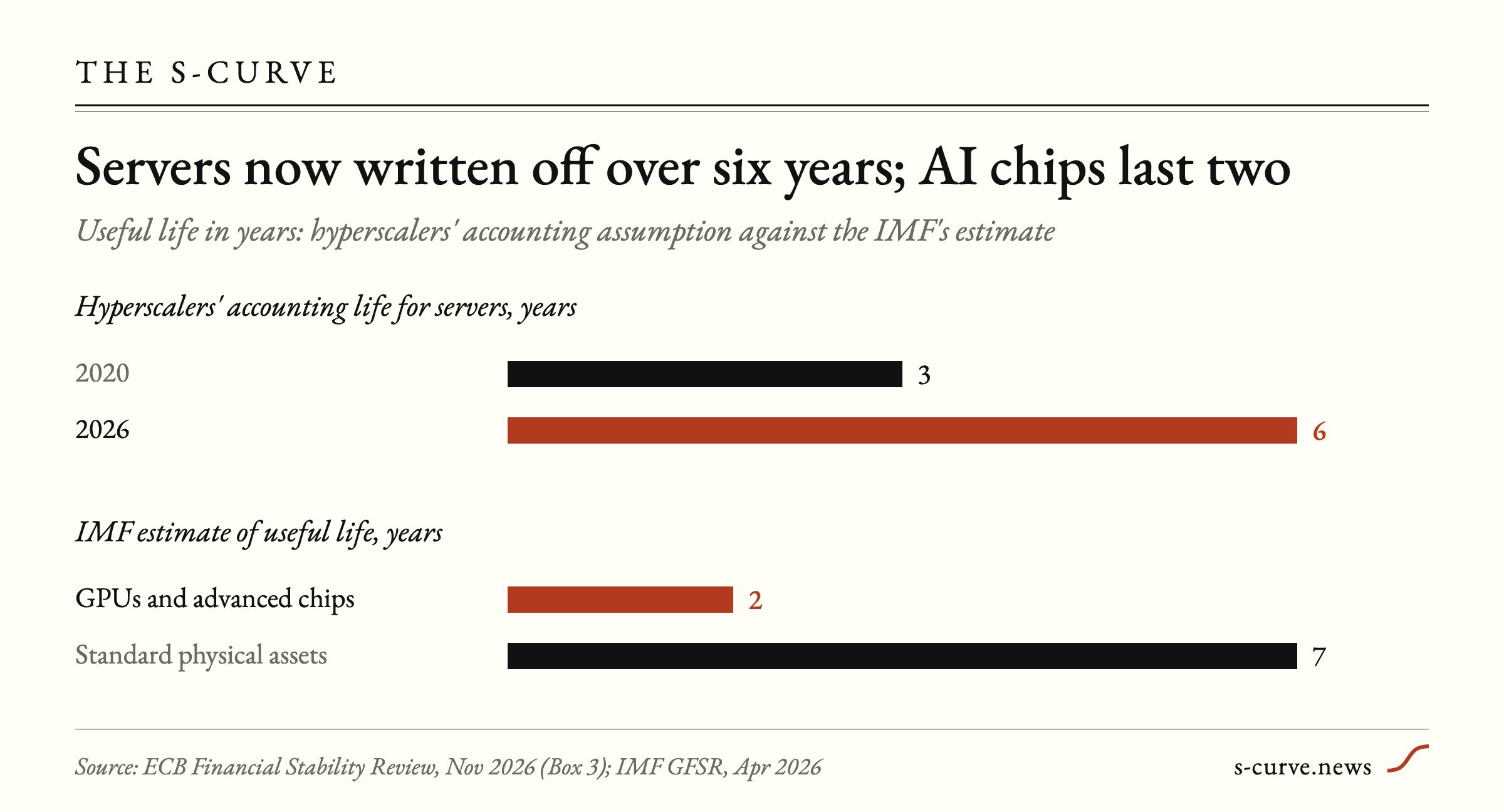
The concern is timing. The ECB cites market intelligence that the economic life of AI equipment is between one and three years. The IMF estimates the average implied useful life of GPUs and advanced chips at two years, against seven for more standard physical assets. Meanwhile most hyperscalers have lengthened the accounting life of servers and network equipment from three years in 2020 to six in 2026.
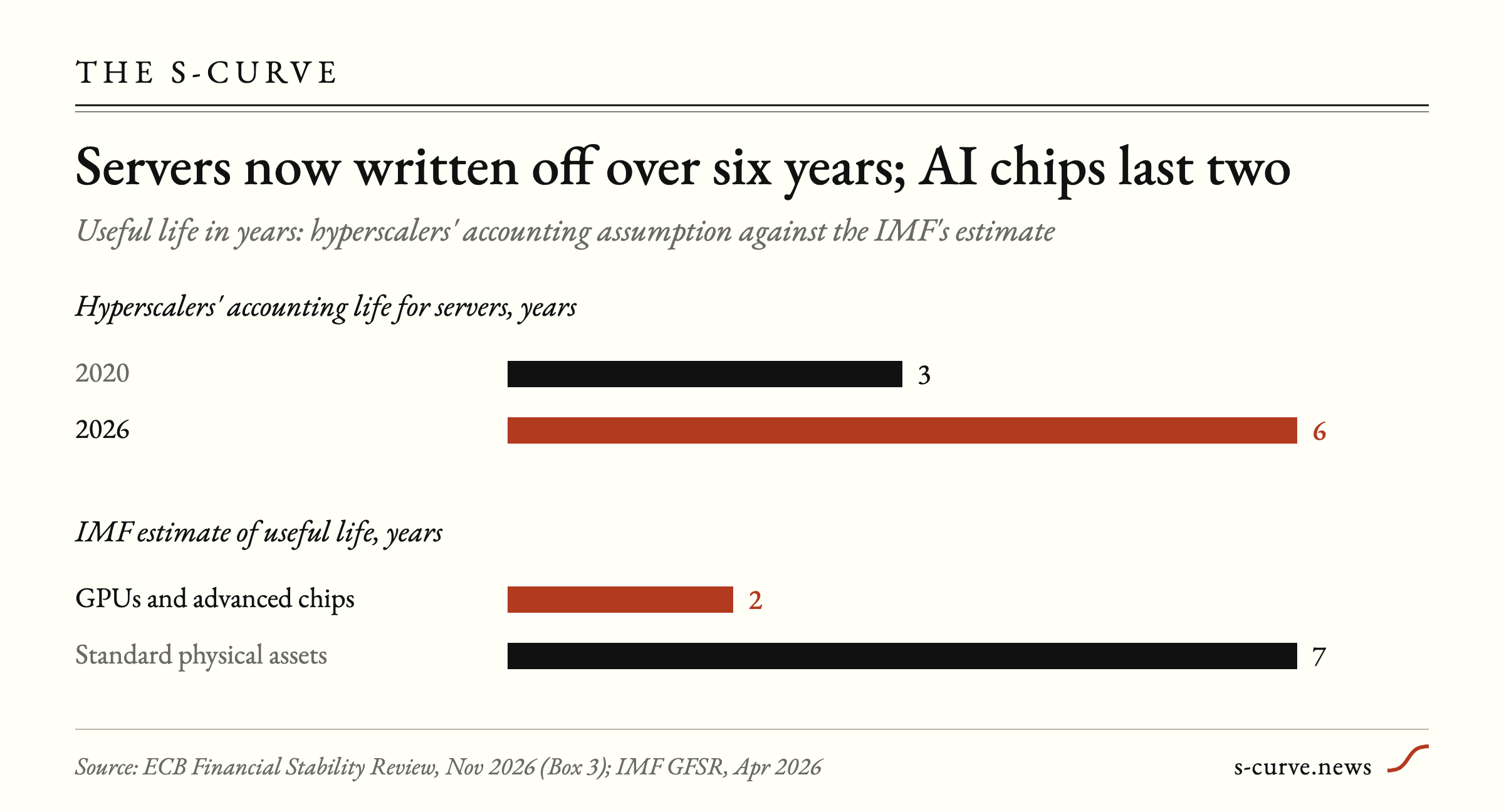
The ECB’s reading is that the maturity of hyperscalers’ outstanding debt exceeds the economic lifetimes of a substantial share of the physical capital it funds, especially advanced chips. Credit spreads on hyperscaler debt have widened relative to similarly rated corporate issuers, particularly at longer maturities.
If earnings disappointed, the ECB says, the full debt would gradually be recognised on balance sheets as asset values were impaired and income projections fell short, and credit ratings and debt ratios could deteriorate.
The other side, and Europe’s exposure
So far, the ECB says, hyperscalers’ earnings have broadly kept up with expectations. The Fed sees a cushion in the structure itself: the largest firms may absorb losses in a downturn, which would soften the effect on the rest of the financial system, although the Fed says their economic exposure may be substantially larger than their on-balance-sheet liabilities suggest. It also says the growth of these obligations deepens connections between the largest tech firms and smaller, riskier firms.
History cuts both ways. The ECB points to the dotcom bubble, which brought overinvestment in infrastructure but only a shallow recession thanks to a large share of equity finance. This time the money is increasingly borrowed, and the ECB says the rapid shift towards debt finance invokes parallels with the dotcom and subprime bubbles.
Europe’s direct exposure through banks is modest. Euro area banks’ lending commitments to 165 important firms in the AI supply chain and their subsidiaries had reached EUR 24.3 billion by June 2026, of which EUR 11 billion was undrawn.European Central Bank: Financial Stability Review, November 2026. The larger channel is bonds: US hyperscalers already account for close to 8% of euro investment-grade bonds maturing after ten years, the ECB says.
The ECB closes its own box with a line that covers both outcomes. Even if AI successfully transforms the global economy, it writes, the credit-driven boom may result in overcapacity, capital misallocation and credit losses for investors.
Sources
- ECB FSR November 2026, Box 3: The debt financing of AI and its implications for financial stability
- ECB FSR November 2026, Box 4: Big tech's growing presence in the euro-denominated bond market
- European Central Bank: Financial Stability Review, November 2026
- Protos: ECB finds $4.5 trillion in hidden AI debt (19 Nov 2026)
- The S-Curve: 2026-11-17-nvidia-108bn-lease-guarantees
- The S-Curve: 2026-11-18-anthropic-900bn-compute-commitments
- Michael S. Barr: Some Potential Financial Stability Implications of Artificial Intelligence (16 Nov 2026)
- Federal Reserve Board: Financial Stability Report, November 2026
Disclosure
This article was drafted by S-Curve Desk, an AI system, from the sources above. Boaz Sobrado reviewed it before publication. Errors: the corrections log, or write to us.