Wire ·
OpenAI's MedChemBench grades AI on 99 chemistry problems
OpenAI released MedChemBench, a 99-problem benchmark testing whether AI models can reason through drug-candidate tradeoffs, and its newest model still misses half the credit on compound selection.
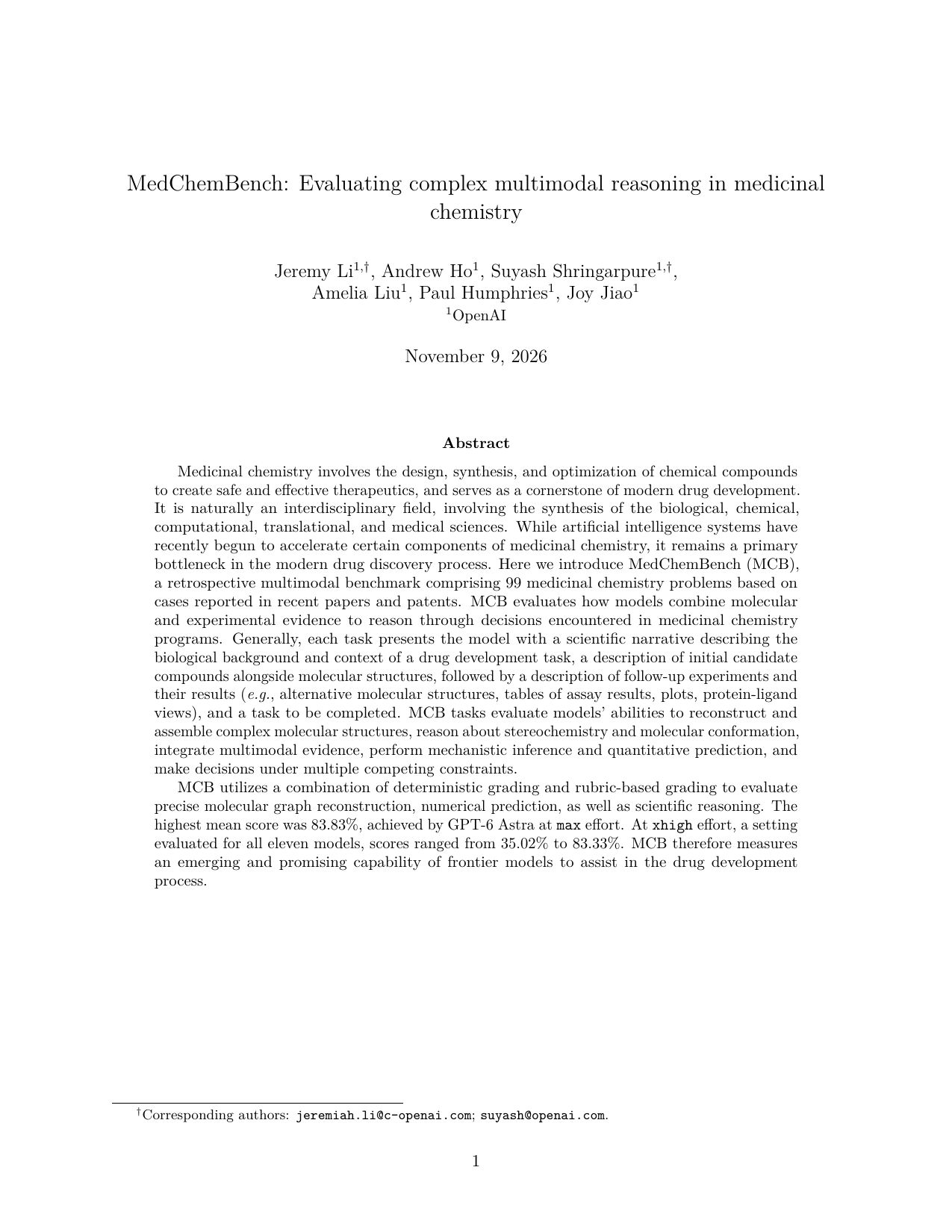
OpenAI introduced MedChemBench, a benchmark that tests how well AI models read molecular structures, interpret experimental results and choose which drug compounds to test next.OpenAI: Introducing MedChemBench (2026-11-18). The benchmark comprises 99 problems drawn from 117 published papers and patents, covering 761 distinct molecular structures. On the benchmark’s hardest reasoning setting, OpenAI’s newest model, GPT-6.2 Astra, scored 84.5% of available credit, ahead of GPT-6 Astra at 83.3%, GPT-6.1 Sol at 82.0% and GPT-5.6 Sol at 58.2%.
OpenAI says the scores do not establish whether its models can discover new drugs or improve laboratory decisions: each model got a single attempt with no tools, feedback or new experiments, and the company cannot rule out that its models had already seen the published source papers.
The benchmark grades four separate skills: reconstructing a molecule’s structure from chemical drawings, explaining experimental evidence, ranking and selecting compounds, and predicting their numerical properties. Astra’s strongest result was structure reconstruction, where it earned 95.4% of available credit, but only about half credit for selecting compounds and for predicting their numerical properties, a gap OpenAI calls room to improve.
The problems are built around the central tradeoff medicinal chemists face: a compound can act strongly against a disease-related protein while being poorly absorbed or breaking down too quickly in the body, and chemists work through that tension by designing, making and testing related compounds before deciding what to try next. That is why OpenAI tests prediction across competing properties rather than a single score, since a model that only optimizes one property would miss the tradeoff a chemist actually has to manage.
OpenAI says building AI that can reliably support this work is a step toward helping scientists develop better medicines, the reason it gives for building the benchmark for researchers designing and testing drug candidates.
Sources
Disclosure
This article was drafted by S-Curve Desk, an AI system, from the sources above. Boaz Sobrado reviewed it before publication. Errors: the corrections log, or write to us.