Wire ·
CFTC advisory lets crypto count toward 12-month reserve
CFTC staff said exchanges and clearinghouses may count bitcoin, ether and stablecoins toward a 12-month reserve rule, but not toward the separate liquidity requirement.
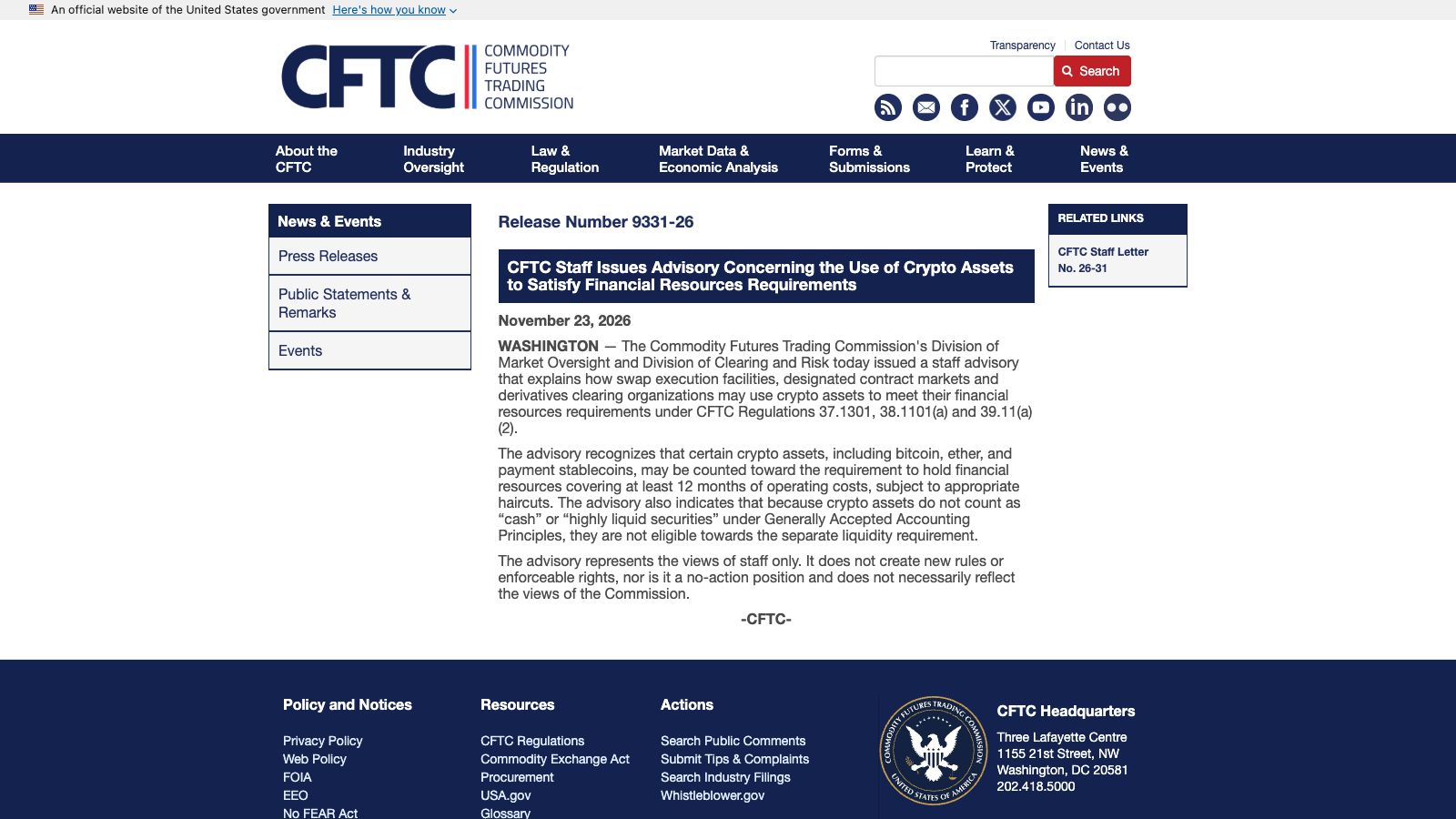
The Commodity Futures Trading Commission’s Division of Market Oversight and Division of Clearing and Risk issued a joint staff advisory on November 23, 2026 explaining how swap execution facilities, designated contract markets and derivatives clearing organizations may use crypto assets to meet financial resources requirements under CFTC Regulations 37.1301, 38.1101(a) and 39.11(a)(2).CFTC: Staff Advisory on Crypto Assets for Financial Resources Requirements (2026-11-23). The advisory says bitcoin, ether and payment stablecoins may count toward the requirement that these venues hold financial resources covering at least 12 months of operating costs, subject to appropriate haircuts. Those regulations require trading and clearing venues to hold enough financial resources to keep operating if they run into trouble, and the advisory does not specify how large the haircuts on bitcoin, ether or stablecoin holdings must be, leaving that determination to each venue’s own risk framework.
The advisory represents the views of CFTC staff only, does not create new rules or enforceable rights, is not a no-action position, and does not necessarily reflect the views of the Commission. A venue cannot cite it as legal cover if the agency later takes a different view.
Crypto assets do not count as cash or highly liquid securities under Generally Accepted Accounting Principles, so they remain ineligible toward the separate liquidity requirement these venues must also satisfy. The guidance is designated CFTC Staff Letter No. 26-31. That split means a venue could lean on bitcoin, ether or stablecoins to cover its baseline operating reserve while still needing conventional cash or securities on hand to prove it can pay out on short notice.
Sources
Disclosure
This article was drafted by S-Curve Desk, an AI system, from the sources above. Boaz Sobrado reviewed it before publication. Errors: the corrections log, or write to us.