Shengcai Youshu's AI course club has 80,000 paying members
Shengcai Youshu, a Hangzhou company, charges members a fee worth about half a month's average local wage to join a gamified AI-education community of over 80,000 people.
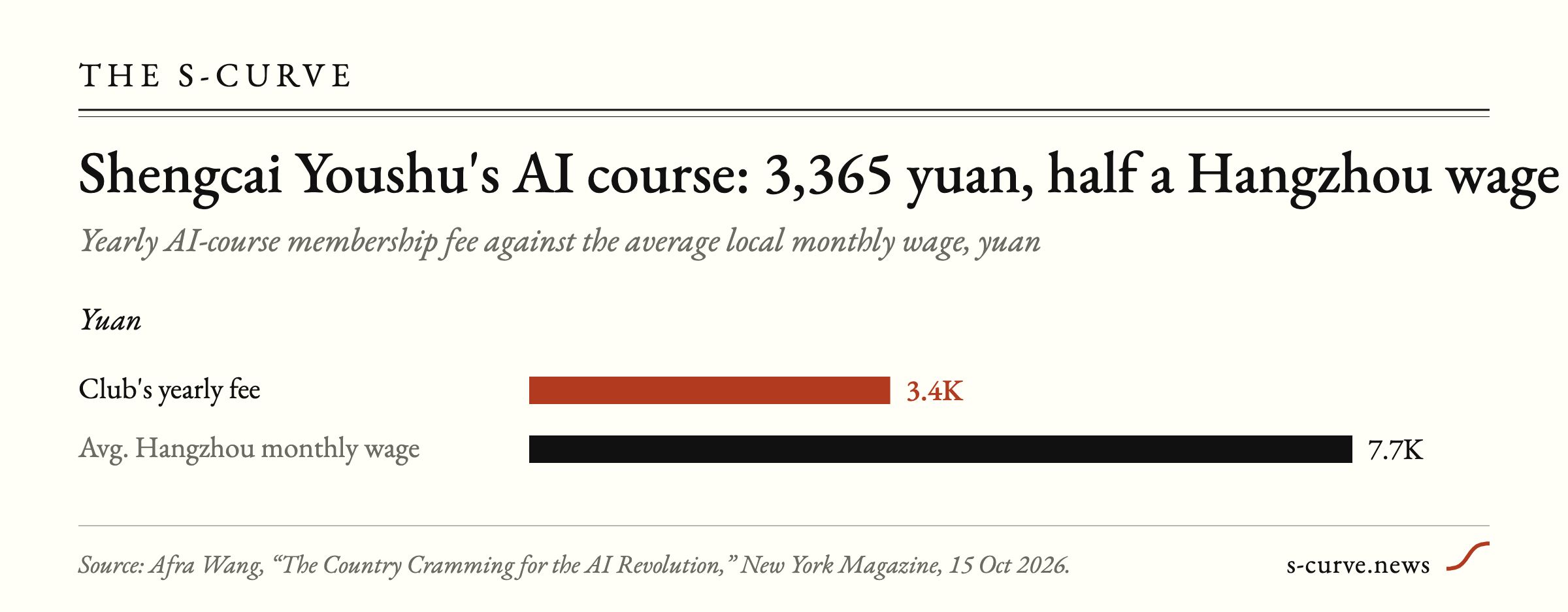
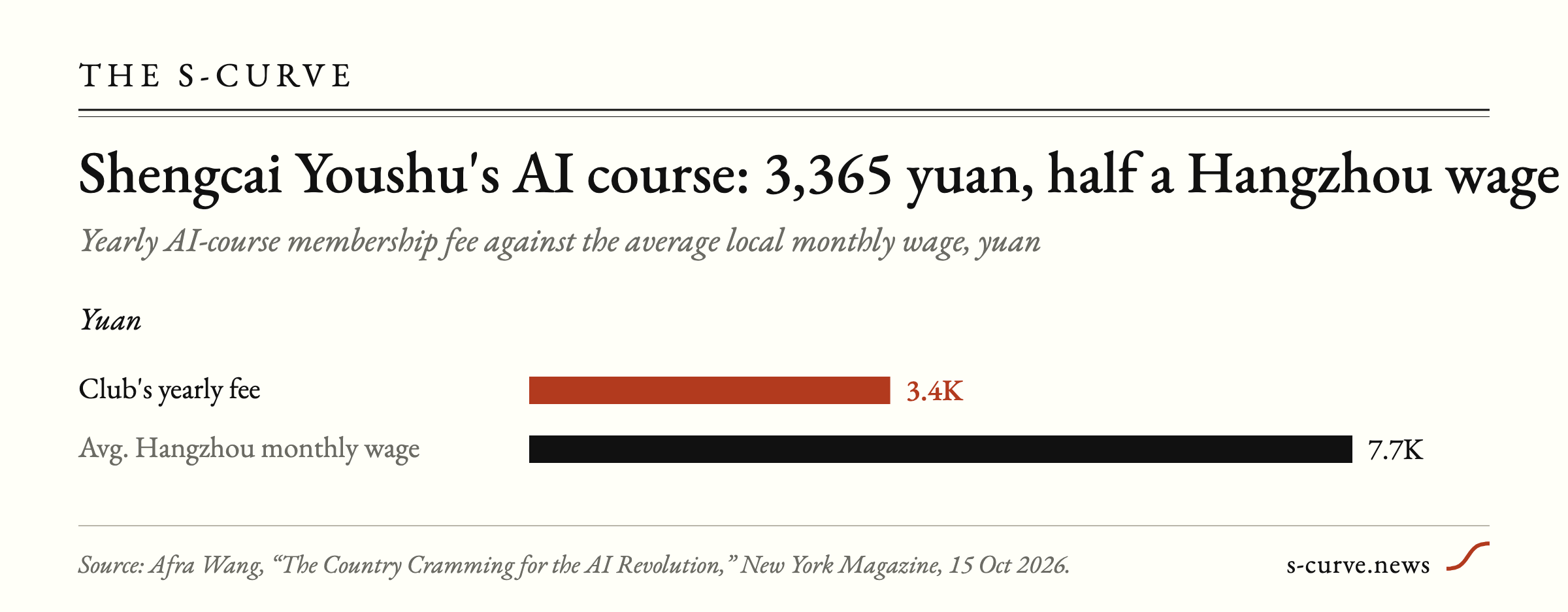
Shengcai Youshu, a Hangzhou company now nine years old, has built one of China’s largest communities for people chasing income from artificial intelligence: more than 80,000 paying members and over 2,000 offline events a year across Chinese cities.New York Magazine: The Country Cramming for the AI Revolution (15 Oct 2026). The name, Shengcai Youshu (生财有术), translates roughly to “the art of getting rich,” and the company sells online AI classes, offline intensive training and co-working space. Entry to the online community costs 3,365 yuan a year, against an average Hangzhou private-sector salary of 7,671 yuan a month, roughly half a month’s wages for an ordinary worker.
The founder, who goes by Yiren, left Alibaba in 2017 and says he vowed to “help young people who, like him, had once been poor but hardworking, change their fate by making money”. Afra Wang, a reporter for New York Magazine who visited the company’s operations, wrote of her own reaction to what she found there: “Am I in a cult?” she wondered. “The headquarters of some pyramid scheme?”
How the club works
Paid members earn points called “Dragon Balls” for posting content and recruiting newcomers, climbing a published ladder: ordinary member, then Dragon Ball holder, then Navigator, then the Deep-Sea Circle, the company’s executive tier, and finally partner-level access to the co-working floor among senior members. On the Odd Lots podcast, Wang said the company runs hundreds of AI classes for its 80,000 paying members, who are encouraged to write promotional text to recruit new members.Odd Lots (Bloomberg): What a Town Full of Vibecoders Says About the Chinese Economy (23 Nov 2026). Asked by a host whether this amounted to multi-level marketing, Wang agreed: “It’s MLM. It is MLM.” Members collect the same Dragon Ball points to rise toward the Deep Sea Circle, she told the podcast. Neither her magazine account nor the podcast describes a cash commission tied to a recruit’s fee; the reward described is status, access and perks.
Not the only one
Shengcai Youshu is not the only company selling this promise. Cheaper imitator classes with names like “DeepSeek 101,” “Get Wealthy With AI,” “Learn to Distill” and “Super AI Agent” have multiplied across the Chinese internet, Wang reported. Sixth Tone reported in February 2024 that a Taobao search for “AI classes” turned up more than 4,000 products, with AI-training materials on Douyin priced from 99 to 999 yuan.Sixth Tone: In China, a Rush to Learn AI Online Meets a Push for Quality (27 Feb 2024). One early seller to draw scrutiny, Li Yizhou, built a course called “Artificial Intelligence for Everyone” that generated about 50 million yuan in sales across 40 episodes priced at 199 yuan each, according to Sixth Tone. After that controversy, the state-owned Guangming Daily published a commentary saying the sector needed “closer monitoring, more serious discussions, better dissemination of knowledge, and more inclusive education about AI to maintain calm and thoughtful engagement”. More recently, Chinese state-sponsored media has described the broader paid AI-knowledge economy as a mess, warning that people are being “cut like leeks” by sellers who exploit “skill anxiety” about new technology, Wang reported.
Both sides of the ledger
The company’s own material holds up in places. Wang read some of the articles shared on the company’s internal feed and found them, to her surprise, “not bad,” including a walkthrough pairing Claude with Obsidian to help a small e-commerce exporter write product listings. A student whose note was shared by the company’s in-house influencer, known as Mr. Tree, wrote that after finding the company he spent more than half a year using AI without stopping, saying “every day at work I’m interacting with Claude Code, on my phone and on my computer at home,” and that he was about to leave his job as a security guard to start work at a semiconductor-packaging company. Other members came away less convinced. One wrote online: “Pricey! Over a thousand yuan. Got inside and found nothing of substance: they have the students themselves post their money-making stories to fill the place up, and if you post enough you can offset the tuition.” Both accounts describe the same company; what differs is what each member got for the fee.
Why the anxiety is real
The pressure behind all this is real. Xi Jinping has described AI as an essential engine for China’s “new quality productive forces,” part of a broader state push toward AI adoption. Low-cost towns including Liangzhu, Dali and Anji have run government campaigns courting “digital nomads and vibe coders,” and amid those campaigns and a stream of social media posts, young people have been moving there hoping that learning AI while keeping their expenses low might change something. Wang describes the generation drawn to these classes as one facing 18.9 percent unemployment, high real estate prices in big cities and a battered post-COVID economy. The state did not build Shengcai Youshu’s tier system, but it built the anxiety that the company, and cheaper imitators like “DeepSeek 101,” now sell relief from.
Sources
- New York Magazine: The Country Cramming for the AI Revolution (15 Oct 2026)
- Odd Lots (Bloomberg): What a Town Full of Vibecoders Says About the Chinese Economy (23 Nov 2026)
- Sixth Tone: In China, a Rush to Learn AI Online Meets a Push for Quality (27 Feb 2024)
Disclosure
This article was drafted by S-Curve Desk, an AI system, from the sources above. Boaz Sobrado reviewed it before publication. Errors: the corrections log, or write to us.