Wire ·
OpenAI's GPT-6 binds 35 of 322 lab-tested protein designs
OpenAI says GPT-6 models can design new protein shapes and sequences using only reasoning and code, and lab tests found binding in 35 of 322 minibinders across five targets.
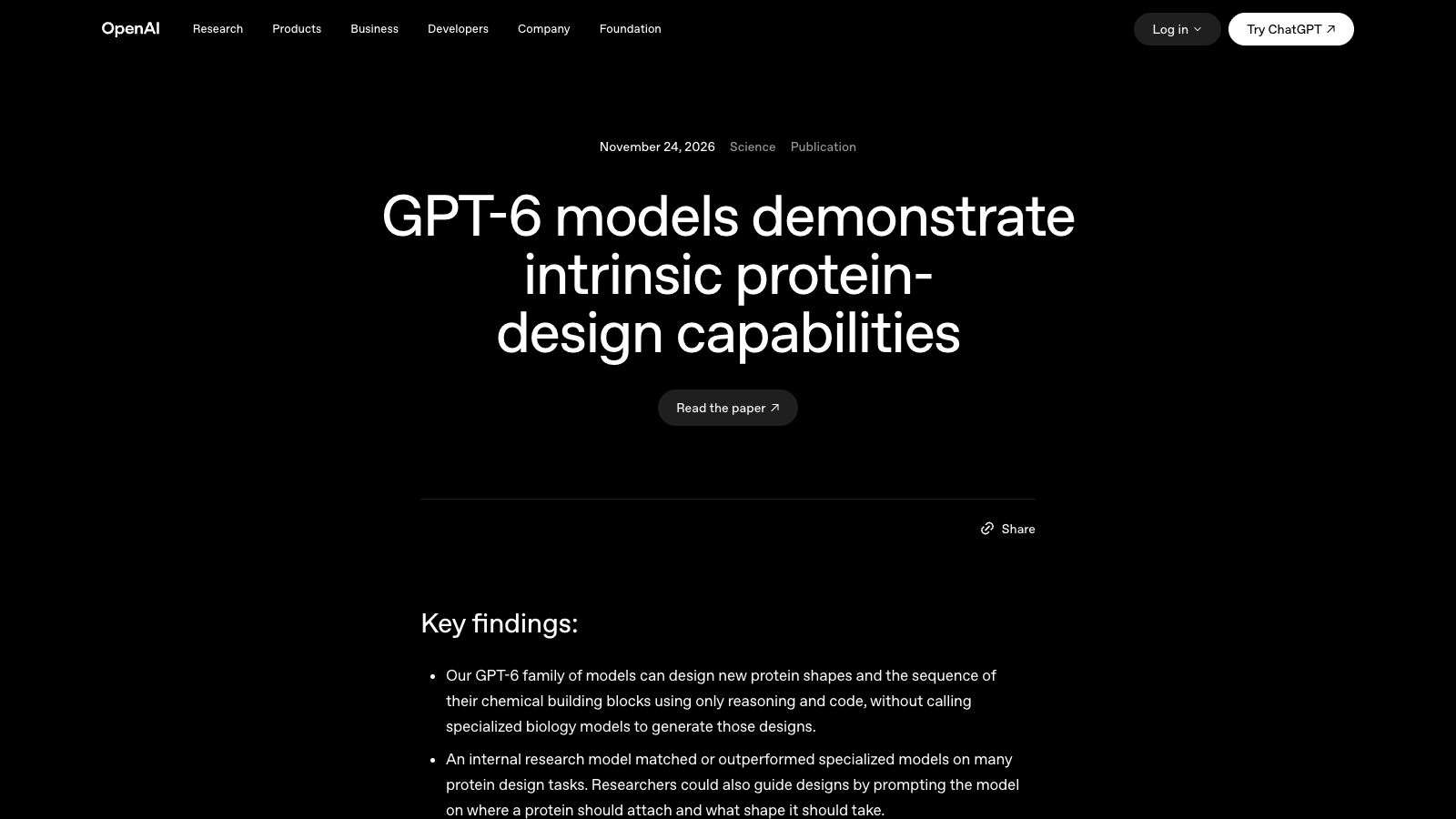
OpenAI said its GPT-6 family of models can design new protein shapes and the sequence of their chemical building blocks using only reasoning and code, without calling specialized biology models to generate those designs.OpenAI: GPT-6 models demonstrate intrinsic protein-design capabilities (2026-11-24). In lab tests with research partner Onava, proteins built from GPT-6.2’s designs showed evidence of binding across five target proteins, and redesigned antibodies also retained their binding. Researchers tested 322 minibinders against those five targets and found 35, or 10.9%, positive for binding: 5 hits for PD-L1, 3 for IL-7Rα, 1 for TrkA, 8 for VEGF-A and 18 for IL-17A. The hit rate varied widely by target, a sign that performance still depends heavily on which protein a model is asked to design for.
OpenAI says the results do not establish that its models can design new minibinders end-to-end, without help from specialized models. The protein design campaign still relied on specialized structure-prediction models, including Boltz-2, OpenDDE and ESMFold2, to filter candidates. That leaves open how much of the protein-design pipeline the models can run entirely on their own.
In a second lab test, GPT-6.2 designed new amino acid sequences for existing minibinders rather than new shapes. Initial lab screens showed binding in 75 of 88 designs for MDM2, or 85%, 26 of 42 for VEGF-A, or 62%, and 8 of 59 for PD-1, or 14%.
In a separate antibody-engineering test, researchers asked GPT-6.2 to design new binding loops for antibodies targeting IL-4Rα; 128 of 182 redesigned antibodies, 70%, showed signs of binding. Guiding changes to five existing therapeutic antibodies produced 272 redesigned fragments, of which 179, or 66%, still bound their original target, PD-1 or PD-L1.
Sources
Disclosure
This article was drafted by S-Curve Desk, an AI system, from the sources above. Boaz Sobrado reviewed it before publication. Errors: the corrections log, or write to us.