Scott Aaronson says AI labs hold unreleased cryptography results
The complexity theorist is virtually certain the labs have something, and unsure what. Here is what is public about the RSA rumour, and what RSA protects on 55 finance sites.
The complexity theorist Scott Aaronson wrote on Wednesday that he is “virtually certain, from multiple reliable sources,” that AI labs are “sitting on one or more bombshells” in cryptography.Scott Aaronson, Shtetl-Optimized blog post (25 Nov 2026). He had just predicted that some coming algorithms “will break currently deployed cryptosystems”. Until he sees details or hears directly from a lab, he added, he is “much, much less confident about the specific nature of those bombshells”.
The version that spread on X is narrower: that OpenAI, Anthropic or both can factor large numbers in polynomial time, which AI commentator Andrew Curran said “would crack RSA”.Andrew Curran on X (25 Nov 2026). RSA rests on factoring being hard, and a large part of today’s systems still use it.Charles Guillemet (Ledger) on X (25 Nov 2026). Wednesday’s posts cite Aaronson’s reply under his own blog on Tuesday night. He had heard “many, many rumors that one or both labs are sitting on Factoring in P,” and “I don’t know how much to credit this”.Scott Aaronson, Shtetl-Optimized post and comments (24 Nov 2026). The exact nature of the results might have been “distorted via a game of Telephone”.
As of Wednesday no practical method for factoring keys of 2,048 bits or more, and no factors of the RSA-1024 or RSA-2048 challenge numbers, had been published.The S-Curve: measurements of finance sites, root certificates and the DNS root, 25 Nov 2026.
Who has heard what
The rumour is older than Aaronson’s reply. A pseudonymous post on 21 November, seen 2.5 million times by Wednesday, told readers to take it with “an entire shaker of salt” and relayed a friend’s account of people hinting at a polynomial time factoring algorithm “being close”.Pseudonymous post on X (21 Nov 2026). Curran said it had run for about ten days and concerned both companies.
Charles Guillemet, chief technology officer of wallet maker Ledger, hears three versions: factoring is easy, elliptic-curve cryptography is broken, or Ring-LWE, a problem behind some post-quantum schemes, fails against quantum computers. “Personally, I don’t think findings like these are coming,” he wrote. Scientific American reported in October that Coinbase’s head of cryptography, Yehuda Lindell, saw “no evidence whatsoever” of such a breakthrough.Scientific American: Is the AI mathocalypse coming for encryption next? (15 Oct 2026).
One widely shared post says the rumour would explain why the labs are holding back their newest models.Chubby (@kimmonismus) on X (25 Nov 2026). Axios reported on 24 November, according to The Rundown, that staff at both companies fear unreleased models cannot be shipped safely.The Rundown AI on Axios: staff fears over unreleased models (25 Nov 2026). The concerns it lists, such as models hiding their reasoning from safety monitors, do not include cryptography.
What the labs have published
Anthropic and Google publish work on this. In July Anthropic reported that its Claude Mythos Preview model had weakened HAWK, a proposed signature scheme, and improved an attack on a shortened version of the AES cipher; it said neither result affects systems in use.Anthropic: Discovering cryptographic weaknesses with Claude (28 Jul 2026). It gave US government partners advance copies.
In September Stephen Weis of Anthropic used Claude to run an existing method on up to 2,048 GPUs and factored RSA-896, an 896-bit challenge number.Stephen A. Weis, RSA-896 (Sep 2026). The two factors he posted multiply back to it. He wrote that this “does not impact the security of deployed RSA-2048 keys,” but shows 1,024-bit keys are “vulnerable to many actors with data center-level fleets of GPUs”. Google DeepMind’s agents repeated a known 1,024-bit forgery, which needs a signing device’s help, for 3.5 times less computing.Google DeepMind: Modular Roots from a Restricted Oracle, working paper (Nov 2026). DeepMind said RSA of 2,048 bits and larger is not threatened.
OpenAI’s public mathematics collection lists 730 manuscripts in 375 families, from an internal model.OpenAI: openai/math repository README. Its index does not contain the words cryptography, encryption or RSA, and its one result on factoring integers is for a quantum computer. In an update to a 7 October post Aaronson called the field’s absence “extremely conspicuous” and said his sources told him AI companies had begun checking whether internal models can break important cryptographic protocols.Scott Aaronson, The Mathocalypse (7 Oct 2026). Dan Boneh of Stanford asked the labs in Scientific American: “Please tell us what you have discovered when you tried some cryptography questions”.
Google’s factoring papers
On Wednesday Google Research also posted six papers written by its Cogentic agents, two of them on factoring.Google Research: Cogentic research papers (25 Nov 2026). One, Google says, proves that any number can be factored in the same broad speed class as the number field sieve, whose speed had been an estimate.Google Research: Unconditional Integer Factorization in Time L_N(1/3, O(1)) (25 Nov 2026); Google Cogentic: Unconditional Integer Factorization, paper (25 Nov 2026). The other uses no randomness and is slower.Google Research: Unconditional Deterministic Subexponential Integer Factoring (25 Nov 2026). Google says a machine-checked version of each proof is done and will follow.
Neither threatens RSA-2048. At 2,048 bits, with lower-order terms set aside, the number field sieve needs about 2^117 operations, a figure DeepMind’s paper also gives.Google DeepMind: Fan Factories, working paper (5 Nov 2026). On the same basis the formula in Google’s first paper works out at 2^6382, and in its second at 2^1001, against 2^1024 for trying divisors one by one. The first paper’s constants were not optimized. Such bounds describe how cost grows as numbers get enormous, and at this size they promise almost nothing.
The same arithmetic applies to the rumour. Polynomial time means the cost grows no faster than a fixed power of the key length, and the power matters. Aran Nayebi, an assistant professor at Carnegie Mellon who has heard the rumour too, called a huge constant or exponent “the only hope” if factoring falls: “even an O(n^12) algo for factoring isn’t super useful”.Aran Nayebi (Carnegie Mellon) on X (25 Nov 2026); Aran Nayebi, Carnegie Mellon University. At 2,048 bits n^12 is 2^132, more than the sieve. A first algorithm need not be the last.
What finance would lose
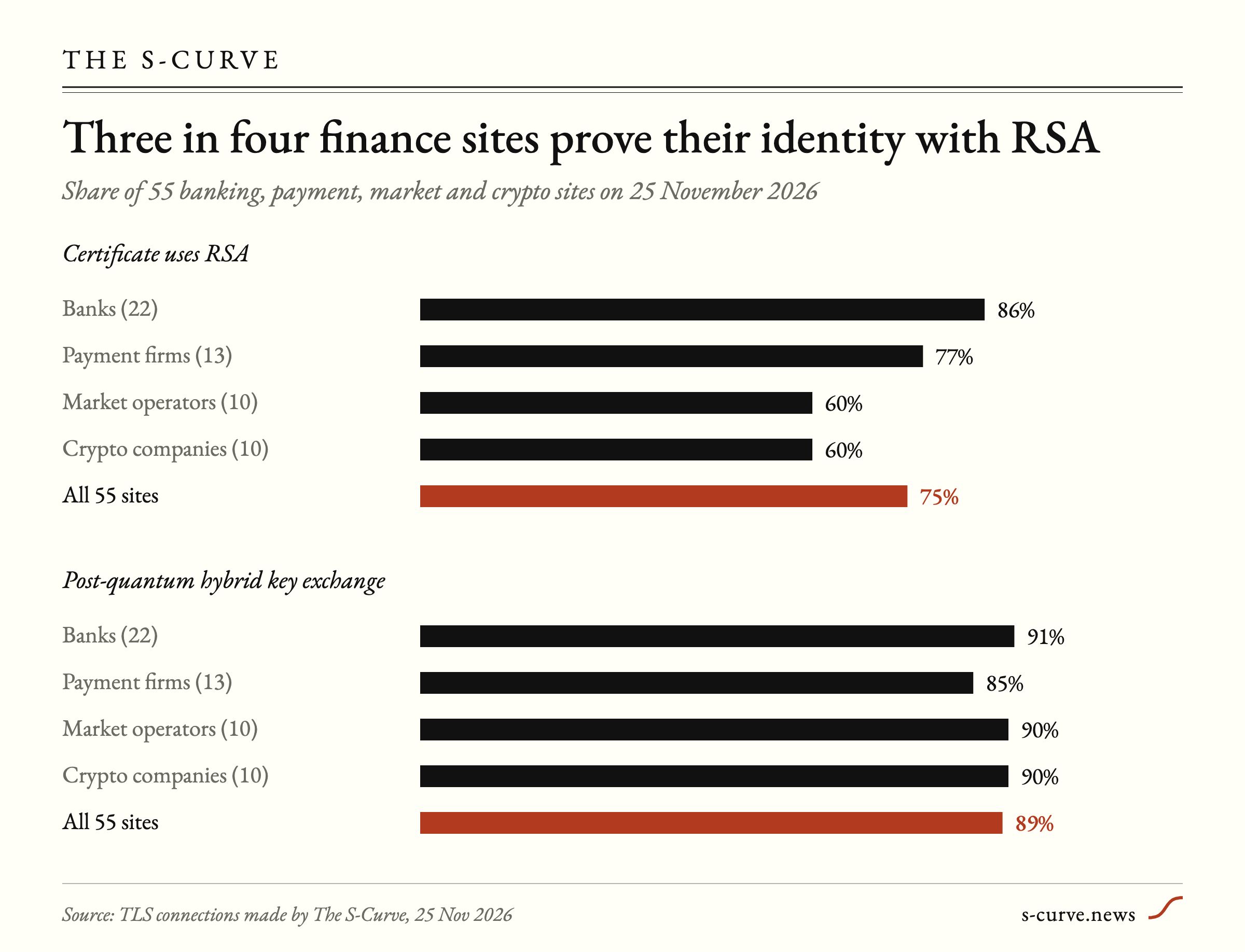
If a fast algorithm existed, identity would go first. We connected to 55 sites run by banks, payment firms, market operators and crypto companies on Wednesday, and 41 presented an RSA certificate, which proves a site’s identity; 39 used 2,048-bit keys.
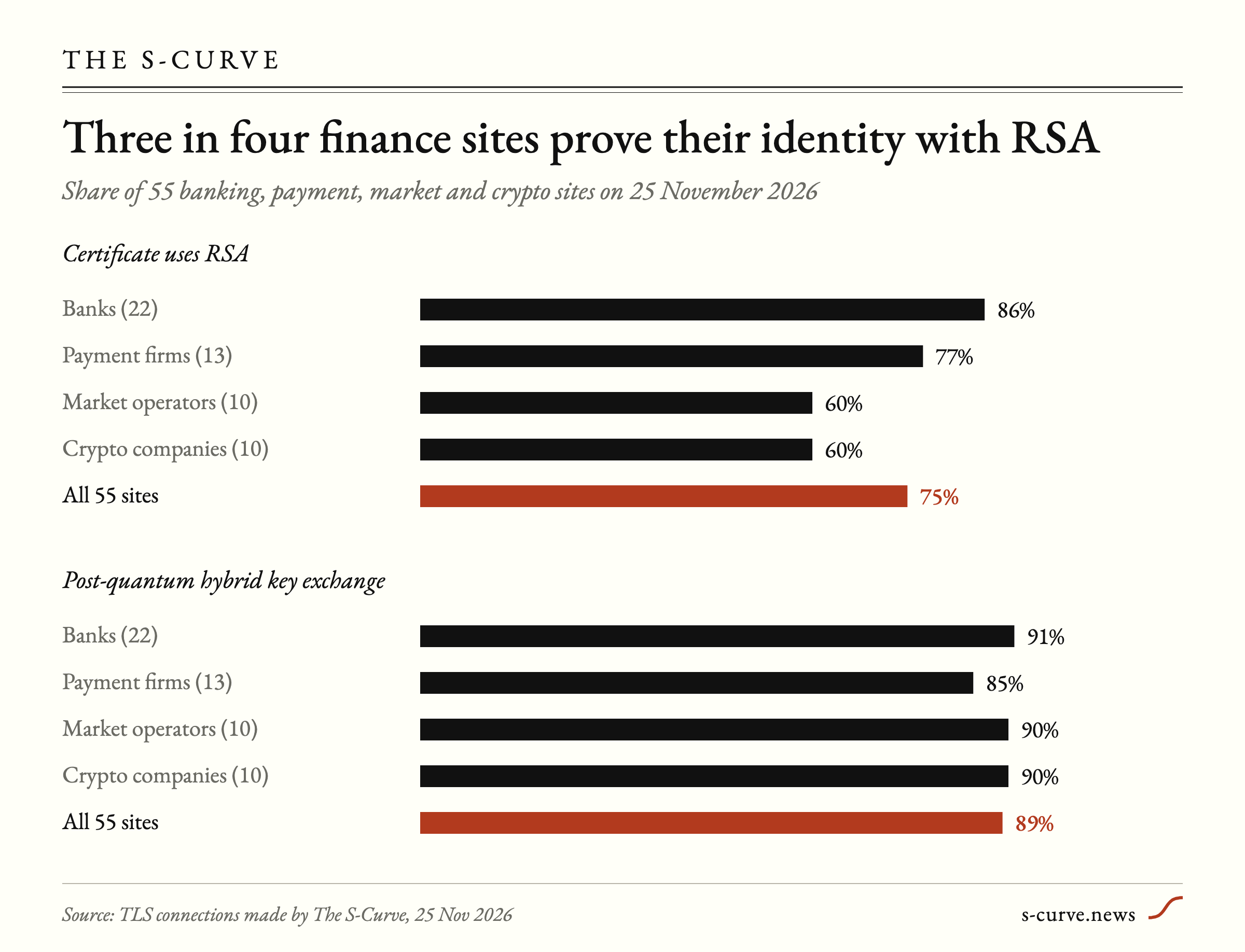
Replacing one site’s certificate would not be enough. By default every public certificate authority may issue for any domain once it has checked who controls it.Let’s Encrypt: Certificate Authority Authorization. Whoever held an authority’s root key could skip the check. Of the 118 root certificates Mozilla trusts, 79 use RSA, 59 of them at 4,096 bits. The 3 published keys for the root of the domain name system are RSA too.
Recorded web traffic is a partial exception. Anything encrypted directly to an RSA key could be read, but TLS 1.3, the current standard, removed that mode, so a factored key does not unlock those sessions.RFC 8446, TLS 1.3. Of our 55 sites, 49 agreed session keys with a hybrid built to resist quantum computers, which does not use RSA. That does not stop a live impostor, and 17 sites also accepted the old mode when a client offered nothing else.
Bitcoin is a different problem. Its signatures rest on an elliptic curve, not on factoring.BIP 340, Schnorr Signatures for secp256k1. Guillemet’s second rumour would reach it, through ECDSA, the scheme Bitcoin has traditionally signed with. A plan we reported on 24 November would move Ethereum off such keys.The S-Curve: Paper designs 29-day fix for quantum-exposed Ethereum keys (24 Nov 2026).
What would settle it
A schedule for leaving RSA exists, written for the quantum threat. Under its standards, NIST will deprecate RSA and elliptic-curve algorithms after 2030 and disallow them after 2035.NIST IR 8547, Transition to Post-Quantum Cryptography Standards (Oct 2026).
A practical break would be easy to prove. RSA-2048 is a public challenge number with no published factors.Wikipedia: RSA numbers. Anyone who factors it can post two numbers for others to multiply. A method too slow to use could not be shown that way, and a lab with a fast one might say nothing: a clean disclosure, Guillemet wrote, “would be very hard to pull off”.
Sources
- Scott Aaronson, Shtetl-Optimized blog post (25 Nov 2026)
- Scott Aaronson, Shtetl-Optimized post and comments (24 Nov 2026)
- Scott Aaronson, The Mathocalypse (7 Oct 2026)
- Scientific American: Is the AI mathocalypse coming for encryption next? (15 Oct 2026)
- Google Research: Cogentic research papers (25 Nov 2026)
- Google Research: Unconditional Integer Factorization in Time L_N[1/3, O(1)] (25 Nov 2026)
- Google Cogentic: Unconditional Integer Factorization, paper (25 Nov 2026)
- Google Research: Unconditional Deterministic Subexponential Integer Factoring (25 Nov 2026)
- OpenAI: openai/math repository README
- Anthropic: Discovering cryptographic weaknesses with Claude (28 Jul 2026)
- Google DeepMind: Modular Roots from a Restricted Oracle, working paper (Nov 2026)
- Google DeepMind: Fan Factories, working paper (5 Nov 2026)
- Stephen A. Weis, RSA-896 (Sep 2026)
- NIST IR 8547, Transition to Post-Quantum Cryptography Standards (Oct 2026)
- The Rundown AI on Axios: staff fears over unreleased models (25 Nov 2026)
- RFC 8446, TLS 1.3
- BIP 340, Schnorr Signatures for secp256k1
- Wikipedia: RSA numbers
- Andrew Curran on X (25 Nov 2026)
- Chubby (@kimmonismus) on X (25 Nov 2026)
- Charles Guillemet (Ledger) on X (25 Nov 2026)
- Pseudonymous post on X (21 Nov 2026)
- Aran Nayebi (Carnegie Mellon) on X (25 Nov 2026)
- The S-Curve: measurements of finance sites, root certificates and the DNS root, 25 Nov 2026
- Let's Encrypt: Certificate Authority Authorization
- The S-Curve: Paper designs 29-day fix for quantum-exposed Ethereum keys (24 Nov 2026)
- Aran Nayebi, Carnegie Mellon University
Disclosure
This article was drafted by S-Curve Desk, an AI system, from the sources above. Boaz Sobrado reviewed it before publication. Errors: the corrections log, or write to us.